Subdividing, Partitioning and Amalgamating Land in Malaysia: Process and Approvals
How to split one land title into several lots, divide land held by co-owners into separate titles, or combine neighbouring lots into one title under the National Land Code: the conditions, approvals, steps, costs and practical tips.
Updated 4 Nov 2026 · PropertyMsia

In short: under the National Land Code (NLC), which applies in Peninsular Malaysia and Labuan, you can split one title into several lots (subdivision), divide land held by co-owners into separate titles (partition), or combine neighbouring lots under one title (amalgamation). Each needs land office approval, usually planning permission from the local council, and a survey before new titles are issued.
1. Three different processes
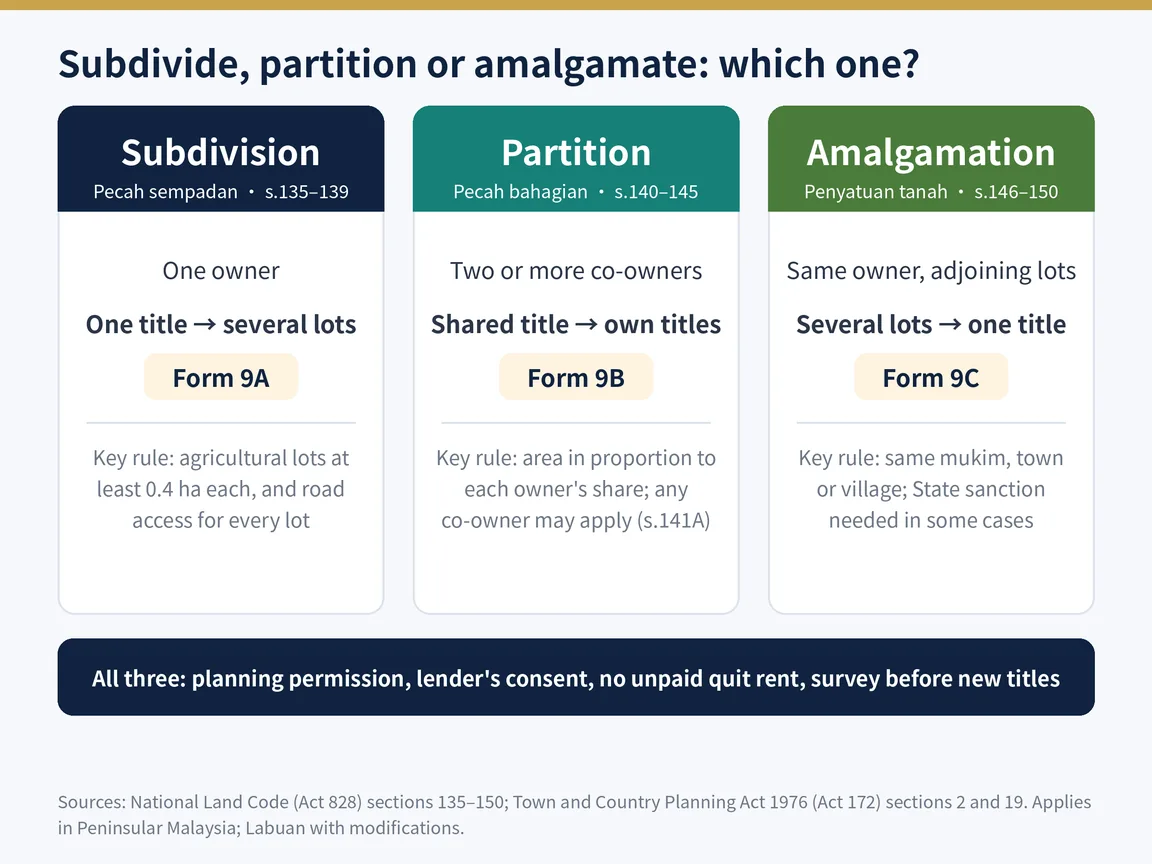
- Subdivision (pecah sempadan), sections 135 to 139: the owner divides the land into two or more portions, each under a separate title. Application in Form 9A.
- Partition (pecah bahagian), sections 140 to 145: land held by two or more co-proprietors is divided so that each gets a separate title for an area as nearly as possible in proportion to his undivided share. Owners who wish to stay together can keep the remainder under one title. Application in Form 9B.
- Amalgamation (penyatuan tanah), sections 146 to 150: an owner of two or more contiguous lots, meaning each shares at least one boundary with another, combines them under a single title. The lots must be in the same mukim, town or village. Application in Form 9C.
Unless the State Authority directs otherwise, the State Director of Lands and Mines approves land under Registry title, and the Land Administrator at the district land office approves land under Land Office title.
2. Planning permission comes first
Under the Town and Country Planning Act 1976 (Act 172), which covers Peninsular Malaysia, "development" includes the subdivision or amalgamation of land, and section 19 bars any development without planning permission. Section 136(1)(c) of the NLC also makes any required planning approval a condition. In practice, the local planning authority approves the layout before or alongside the land office application. Kuala Lumpur follows the Federal Territory (Planning) Act 1982, and Sabah and Sarawak have their own land laws.
3. What the land office checks
Section 136(1) lists the conditions for subdivision, and most also apply to partition and amalgamation:
- No breach of any restriction in interest on the title, or of any other law.
- Planning approval obtained, with no conflict with an approved development plan.
- No outstanding land revenue, such as unpaid quit rent.
- Written consent of every chargee (the lender), lessee and lien holder.
- Minimum lot size: for agricultural land, each portion must be at least two-fifths of a hectare (0.4 ha, just under 1 acre). For other land, the planning authority sets the minimum.
- A suitable shape for the intended use, and access to a road for every lot. This may mean surrendering land for a road, building a private road or a Land Administrator's right of way.
- Land shown for public use in the approved layout must be surrendered to the State.
4. The process step by step
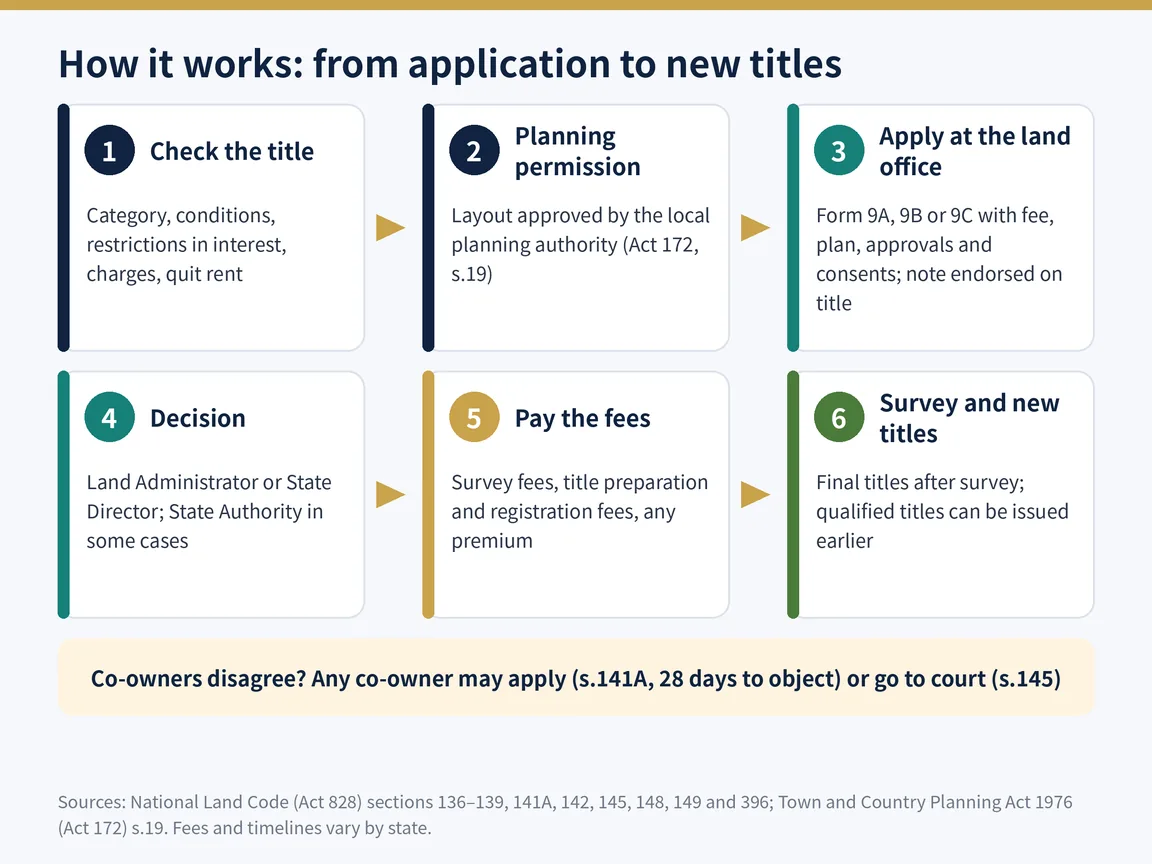
Once the application is received, a note is endorsed on the title. The Land Administrator or State Director then approves it, with minor changes if needed, or rejects it. After approval you pay the survey fees and the fees for preparing and registering the new titles. Final titles are issued only after each lot is surveyed, although the owner can apply for qualified titles before the survey is completed.
5. When co-owners do not agree
Under section 141A, any co-proprietor may apply for partition even if the others do not join in or consent. The Land Administrator gives the other co-proprietors 28 days to object and holds an enquiry if they do. Agricultural land of 0.4 ha or less goes to the State Authority for approval (section 143A). A co-owner can also go to court under section 145, which may order the partition, the transfer of a share to the other co-owners, or the sale of the land.
6. When amalgamation needs State sanction
The State Authority must also sanction an amalgamation when the lots are all under Land Office title and together exceed 4 hectares, when some lots are under Registry title and others under Land Office title, or when the lots differ in tenure period, rent rate, land-use category, conditions or restrictions. The State can then set the tenure, rent and conditions for the combined lot, and charge a premium for any lease extension.
7. Costs and practical tips
Fees are set by each state's land rules. For example, PTG Penang lists an application fee of RM50 for each new lot (minimum RM200) and RM100 per new lot to register a final title. Survey fees, consultants' fees and any local council or State charges come on top, so check current rates with your land office.
- Check the title first: category of land use, express conditions, restrictions in interest, charges and caveats.
- If the land is charged, get the lender's written consent early, and settle any quit rent arrears before applying.
- Roads and public land reduce the net area you can sell.
- Agricultural land can apply to subdivide and change its category or conditions at the same time under section 124A (Form 7D).
- Agricultural estate land of 40 hectares or more is referred to the Estate Land Board.
- Buying a lot "pending subdivision"? Ask for the approval letter; your own title comes only after the survey.
This is a general guide, not legal advice. Procedures and fees differ between states.
Planning to subdivide, partition or combine land? Chat with PropertyMsia on WhatsApp and we will help you plan the next step.
Talk to a registered agent for free advice on pricing, zoning and due diligence.
Get in touch Land Listings