Sale and Leaseback of a Factory in Malaysia: How It Works, Tax, Stamp Duty and Lease Terms
A plain-English guide to selling your factory and renting it back: why owners do it, how the sale agreement and lease fit together, RPGT and the buyer's retention, stamp duty on the transfer and the lease, consents, fair rent, who pays the outgoings, service tax, risks and a due-diligence checklist.
Updated 29 Nov 2026 · PropertyMsia
In short: In a sale and leaseback, a business sells the factory it occupies to an investor and rents it straight back, so it gets cash while production carries on. The seller may owe Real Property Gains Tax (RPGT), the buyer pays stamp duty on the transfer, and the lease is stamped too. This is general information for Peninsular Malaysia, not legal or tax advice.
1. Why owners do it
It releases capital locked in land and buildings for machinery, working capital or repaying debt, without moving the production line. The buyer gets a ready tenant. The trade-off: the seller gives up future capital growth and takes on rent.
2. How the deal works
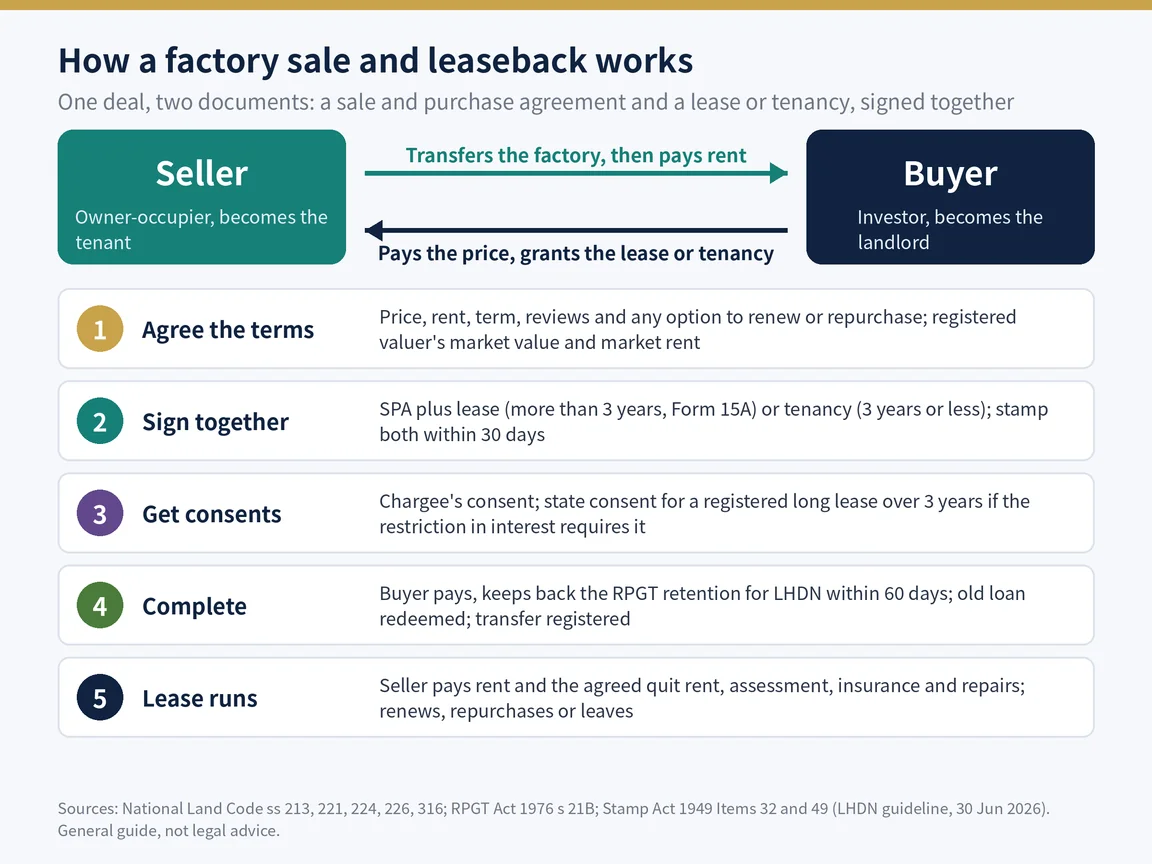
- Two documents, one deal: a sale and purchase agreement (SPA) and a lease or tenancy agreement, signed together, fixing the rent, reviews and term, with the lease starting on completion.
- Options: to renew, or to repurchase at an agreed price or formula. Your lawyer can protect an option, for example with a private caveat.
- Completion: the buyer pays the balance, the seller's loan is redeemed, the transfer is registered and the lease begins.
3. Lease or tenancy: registration and consents
Under the National Land Code (NLC), a tenancy of three years or less is exempt from registration (s 213). It does not bind a later buyer or chargee unless endorsed on the title (s 316). A term of more than three years must be a registered lease in Form 15A (s 221). An option to renew is ignored when counting the term (s 224), so "3 + 3 years" is still a three-year tenancy.
If the title carries a restriction in interest, the transfer may need state consent, and so may a registered long lease of more than three years, depending on the wording; short tenancies of three years or less are not affected. If the buyer's lender registers a charge first, the lease or tenancy needs the chargee's consent (s 226). See our industrial land titles guide and leases vs tenancies guide.
4. RPGT for the seller
Rates by seller and holding period (RPGT Act 1976, Schedule 5):
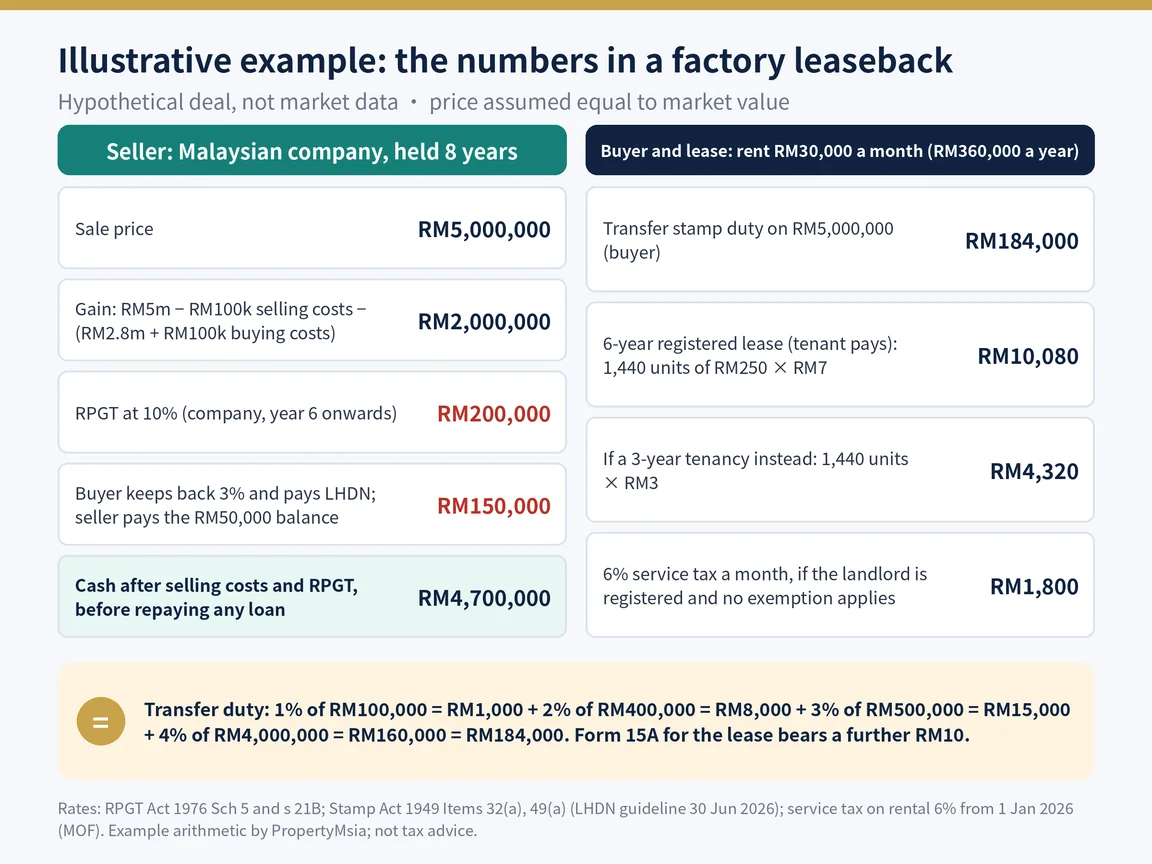
- Individual citizens and PRs: 30% within three years, 20% in year 4, 15% in year 5, 0% from year 6, plus an exemption of RM10,000 or 10% of the gain, whichever is higher.
- Malaysian companies: 30%, 20% and 15%, then 10% from year 6, with no exemption.
- Non-citizens and foreign companies: 30% up to year 5, then 10%.
The buyer must keep back 3% of the price (5% if a Malaysian company sells within three years; 7% for a foreign seller) and pay it to LHDN within 60 days; it is credited against the seller's RPGT. Both sides file through e-CKHT on MyTax. Past Industrial Building Allowance claims may trigger a balancing charge (see our IBA guide).
5. Stamp duty on the transfer and the lease
The buyer pays transfer duty on the price or market value, whichever is higher: 1% on the first RM100,000, 2% up to RM500,000, 3% up to RM1,000,000 and 4% above (Item 32(a)); a flat 4% applies to a foreign company or a non-citizen who is not a PR (Item 32(aa)). A below-market price does not cut the duty.
The lease or tenancy is stamped on the annual rent (Item 49(a)): for every RM250, RM1 for up to one year, RM3 for over one to three years, RM5 for over three to five years and RM7 for over five years. The tenant pays; Form 15A then bears a fixed RM10. Stamp online through e-Duti Setem on MyTax within 30 days of signing.
6. Fair rent and who pays what
Ask a registered valuer for both market value and market rent. A high price with high rent, or the reverse, shifts value between the parties (see our factory valuation guide).
Leasebacks are often "triple-net": the tenant pays quit rent, assessment, building insurance and repairs on top of rent, though the registered owner stays answerable to the land office and council. If the landlord is registered for service tax, 6% applies to the rent from 1 January 2026 unless an exemption applies, for example for SME tenants with annual sales up to RM1.5 million. The tenant can deduct business rent (Income Tax Act 1967, s 33(1)(b)).

7. Risks for both sides
- Seller-tenant: loses capital growth; rent rises at reviews; default can mean forfeiture; a repurchase price may exceed market value.
- Buyer-landlord: depends on one tenant; a specialised factory can be hard to relet; unapproved works or contamination pass to the owner.
8. Due-diligence checklist
- Official title search: owner, category, express conditions, restriction in interest, charges and caveats.
- CCC or CF, approved plans and fire certificate.
- Market value and market rent from a registered valuer; the seller's accounts and a deposit or bank guarantee.
- Lease terms: reviews, outgoings, repairs, insurance, options, default, reinstatement.
- Consents: chargee, state (long leases, where required) and board resolutions.
- RPGT, IBA, stamp duty and service tax costed before signing.
See also our factory due diligence checklist, factory RPGT guide and factory renting guide.
Sources: NLC, RPGT Act 1976, Stamp Act 1949, Income Tax Act 1967, LHDN, MOF, Customs (November 2026).
Thinking of selling your factory and leasing it back, or buying one with a tenant in place? Chat with PropertyMsia on WhatsApp and we will help you check the details before you commit.
Talk to a registered agent for free advice on pricing, zoning and due diligence.
Get in touch Industrial Listings