
How a Factory Is Valued in Malaysia: Comparison, Income and Cost Approaches
How registered valuers in Malaysia put a value on a factory or warehouse: the comparison, income and cost approaches, what drives an industrial property's value, and how the valuation affects your loan and stamp duty.
Updated 2 Nov 2026 · PropertyMsia

In short: a factory's value is not just the price the seller asks. In Malaysia, only a registered valuer may value property for a fee, and they follow the Malaysian Valuation Standards using three approaches: comparison, income and cost. Knowing how they work helps you negotiate the price, plan your financing and check your stamp duty.
1. Who values a factory
Under the Valuers, Appraisers, Estate Agents and Property Managers Act 1981 (Act 242), only a registered valuer with an authority to practise from the Board of Valuers (sections 19 and 21) may value land and buildings for a fee. You will usually meet three kinds of valuation:
- The bank's panel valuer, who values the factory for your loan.
- A private valuer you appoint, for example before you buy, sell, restructure or settle a dispute.
- The Valuation and Property Services Department (JPPH), the government valuer, which the Stamp Office can ask for the market value when a transfer is stamped.
2. The comparison approach
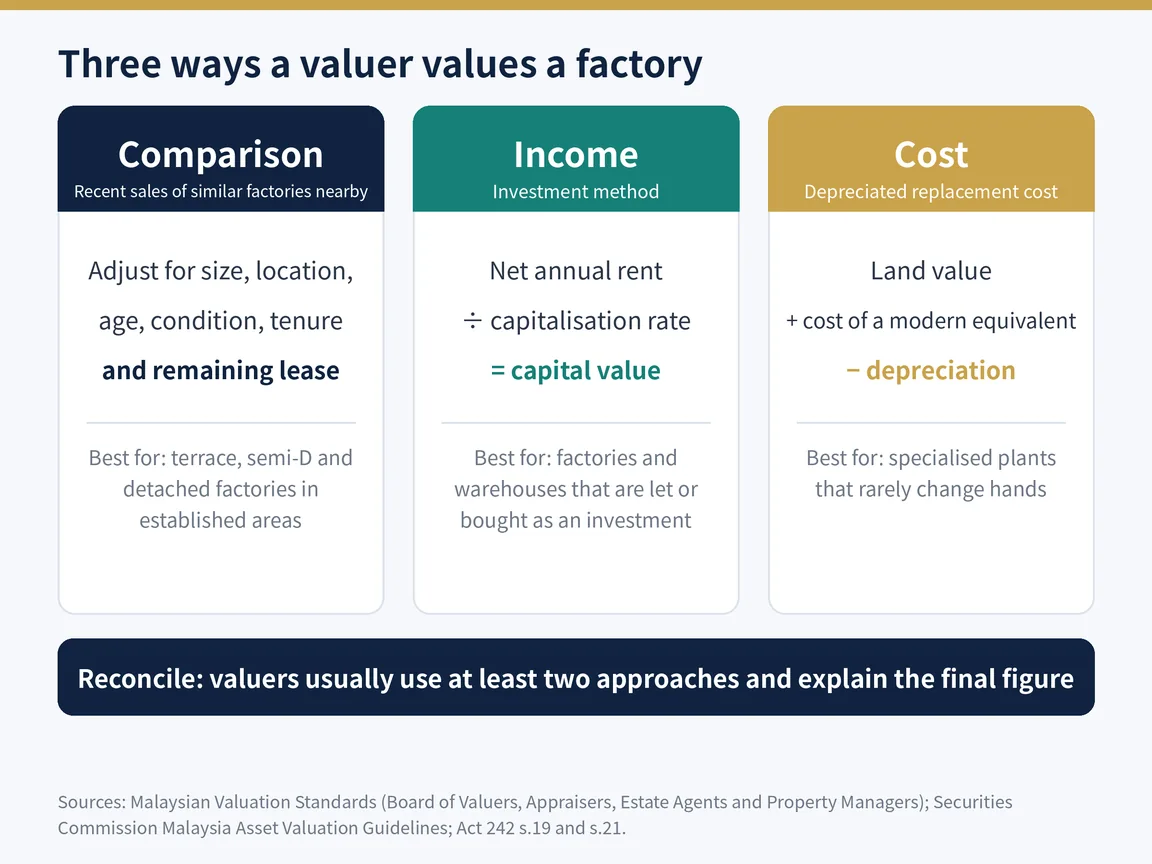
The valuer looks at recent sales of similar industrial properties nearby, usually by lot or title number, date, price, tenure and land and built-up area, then adjusts each one for differences such as size, location, age, condition and remaining lease. This is the main approach for common factory types like terrace, semi-detached and detached factories in established industrial areas, because there are enough sales to compare.
3. The income approach
For a factory or warehouse that is rented out, or bought as an investment, the valuer can use the investment method. They estimate the market rent, deduct outgoings such as quit rent, assessment, insurance and repairs, and divide the net annual income by a capitalisation rate taken from comparable deals. A higher rent or a lower capitalisation rate gives a higher value, so the valuer must show evidence for both.
4. The cost approach
For specialised plants that rarely change hands, the valuer may use the depreciated replacement cost method. The value is the land value plus the cost of putting up an equivalent modern building today, less depreciation for age and wear, an outdated design, or a weak location. The Securities Commission's Asset Valuation Guidelines, for example, ask valuers to use at least two approaches and explain how they reconcile the results.
5. What drives a factory's value
- Title and tenure: freehold or leasehold, the years left, the land category (industry) and express conditions, and any restriction in interest, such as a Bumiputera lot or a need for state consent to transfer.
- Land and building: land area, built-up area, the share of office and production space, clear height, floor loading and the yard for container lorries.
- Power and services: the electricity supply capacity, water, drainage and fire protection.
- Approvals: a Certificate of Completion and Compliance (CCC) or Certificate of Fitness, and no unapproved extensions. Valuers note breaches and usually do not value illegal structures.
- Location: access to highways and ports, the labour pool and the neighbouring uses.
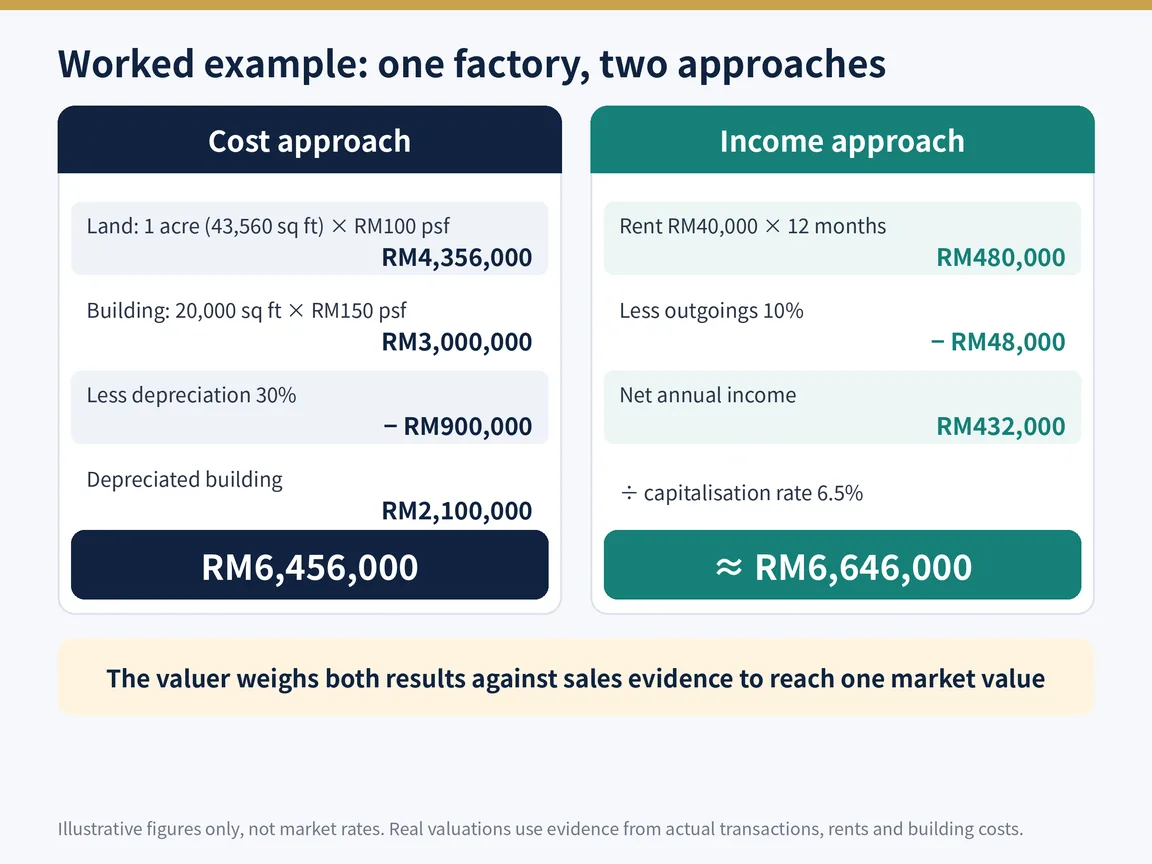
The figures in this example are for illustration only and are not market rates. Real valuations use evidence from actual transactions.
6. Why the valuation matters when you buy or sell
- Financing: banks usually base the loan on the lower of the purchase price and the valuation. If the valuation comes in below the price, you will need more cash for the shortfall.
- Stamp duty: duty on a transfer is charged on the price or the market value, whichever is higher. If the Stamp Office's assessment, often based on JPPH's valuation, is higher than your price, you can object under section 38A of the Stamp Act 1949, ideally supported by your own valuer's report.
- Negotiation: a valuation done before you sign gives both sides an independent view of the price.
7. Practical tips
- Check that the valuer is registered with the Board of Valuers before you appoint them.
- Give the valuer the title, approved building plans, CCC and any tenancy agreements, so the report is complete.
- Read the comparables in the report, not just the final figure.
- Remember that a valuation is a professional opinion at a given date, and markets move.
This is a general guide, not professional valuation or legal advice.
Buying or selling a factory or warehouse? Chat with PropertyMsia on WhatsApp and we will help you understand its value before you commit.
Talk to a registered agent for free advice on pricing, zoning and due diligence.
Get in touch Industrial Listings