
Yearly Holding Costs of a Shoplot or Office in Malaysia: Quit Rent, Assessment Tax and More
What it costs each year to own a shoplot or office in Malaysia: quit rent, assessment tax, the strata maintenance fee, sinking fund and insurance. Who pays, when each is due, what happens if you pay late, and how to object to your assessment.
Updated 3 Nov 2026 · PropertyMsia

In short: owning a shoplot or office comes with yearly bills: quit rent to the state, assessment tax to the council and, for strata units, the maintenance fee and sinking fund, plus insurance. Commercial rates are usually higher than for homes, so budget for them.
1. Quit rent (cukai tanah)
Quit rent is the yearly rent paid to the State Authority under the National Land Code. Each state fixes its own rates by land category, location and area.
- Who pays: the registered proprietor, or someone on their behalf (section 95).
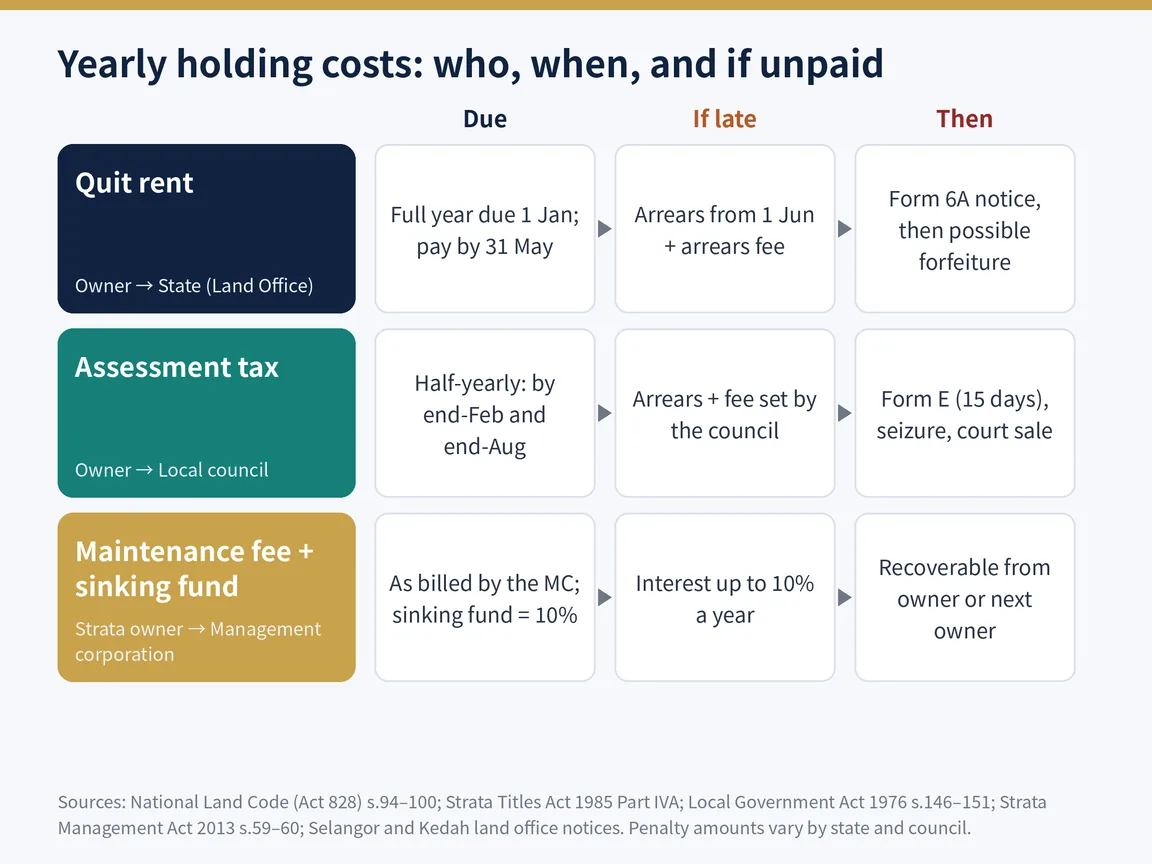
- When: the full year falls due on 1 January and becomes arrears on 1 June if unpaid (section 94(2)).
- If you pay late: an arrears fee is added under state rules. A Form 6A notice of demand follows (section 97); land offices in Selangor and Kedah give three months to settle, after which the land can be forfeited (section 100).
- Strata units: where parcel rent is in force under Part IVA of the Strata Titles Act 1985, each owner pays rent for their own parcel, on the same 1 June arrears rule (section 23C), with a Form 11 notice and possible forfeiture (section 23H).
Selangor no longer posts bills; owners download them from the state e-Tanah portal. Most states offer online payment.
2. Assessment tax (cukai taksiran or cukai pintu)
Assessment tax is imposed by the city, municipal or district council under Part XV of the Local Government Act 1976. It is calculated as annual value × rate (section 130). Annual value is the estimated gross yearly rent, assuming the landlord pays repairs, insurance and upkeep; for vacant land it is 10% of market value.
- Commercial costs more: section 129 lets councils set different rates according to how a property is actually used. DBKL, for example, publishes 10% for commercial buildings (inside its 36-square-mile area) against 4% for residential buildings. MBPP's 2025 rates are 9% for commercial and 5.6% for landed homes.
- Who pays: the owner. Unpaid rates are a first charge on the property (section 146).
- When: in two half-yearly instalments. Any amount unpaid at the end of February or August becomes arrears, and the council can add a fee (section 147).
- If you pay late: after a Form E notice giving 15 days to pay, the council can issue a warrant to seize movable property on the premises (section 148), even goods belonging to someone else, and as a last resort seek a High Court order to sell the property (section 151).
3. Checking and objecting to your assessment
When a council revises its Valuation List, owners are notified and may object in writing at least 14 days before the revision date (section 142). Amendments after renovation or a change of use have their own objection period (section 144). If the council rejects your objection, you can appeal to the High Court within 14 days, but you must pay the rate first (section 145). You can object to the valuation, not the rate itself.
4. Strata units: maintenance fee and sinking fund
The management corporation sets the maintenance fee by share units, and may set different rates for parcels used for significantly different purposes, such as shops and homes in a mixed development (Strata Management Act 2013, section 60). A sinking fund contribution of 10% of the maintenance fee is collected on top (section 59). Late payment can carry interest of up to 10% a year, and arrears can be recovered from the next owner.
5. Insurance
In a strata building, the management corporation must insure the building under a damage policy. The cover must be for at least its reinstatement value, revalued by a registered valuer at least every five years (sections 93 and 94), and the premium is paid from the maintenance account. Insure your own renovations, stock and contents. For a landed shoplot, the owner arranges fire insurance, which financing usually requires.
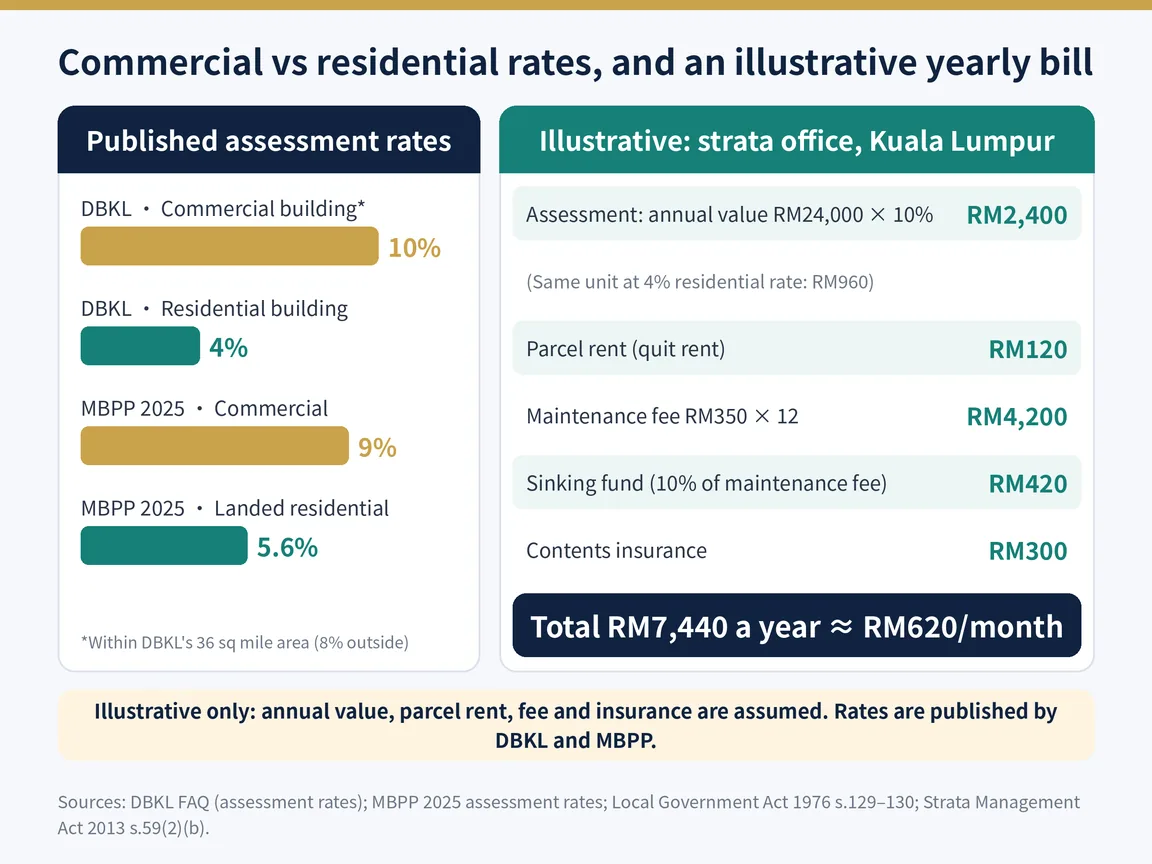
Illustrative example: the annual value, parcel rent, maintenance fee and insurance are assumed figures; only the DBKL and MBPP rates are published. Your bills will differ.
6. If you rent the unit out
Quit rent and assessment are the owner's liability; most commercial tenancies keep it that way, but read the outgoings clause. If the owner defaults, the law lets a tenant pay the land office or council and deduct the sum from the rent (NLC section 98; Local Government Act 1976 section 151).
7. Practical tips
- Before buying, ask for the latest quit rent and assessment receipts and the management corporation's statement of account.
- Check the sale and purchase agreement for how these outgoings are split up to completion.
- Mark 31 May, end-February and end-August in your calendar.
- Include all of these costs in your net rental yield.
This is a general guide, not legal or tax advice; rates vary by state and council.
Thinking of buying or renting out a shoplot or office? Chat with PropertyMsia on WhatsApp and we will help you work out the real yearly cost.
Talk to a registered agent for free advice on pricing, zoning and due diligence.
Get in touch Commercial Listings