
RPGT and Stamp Duty When Buying or Selling a Shoplot or Office in Malaysia
How RPGT and stamp duty work on a Malaysian shoplot or office deal: MOT tiers for Malaysian buyers, the flat 4% foreign rate on non-residential property, RPGT by seller and holding period, buyer retention to LHDN, and a worked RM2 million example.
Updated 6 Nov 2026 · PropertyMsia

In short: when a shoplot or office changes hands, the seller may owe Real Property Gains Tax (RPGT / CKHT) on the profit, and the buyer pays stamp duty on the Memorandum of Transfer. First-home stamp duty relief does not apply to commercial property. RPGT depends on who sells and how long they held the unit; stamp duty depends on the higher of price or market value. Know both before you sign.
1. Who pays what
- Seller (disposer): RPGT on the chargeable gain under the Real Property Gains Tax Act 1976, collected by LHDN (HASiL).
- Buyer (acquirer): stamp duty on the MOT (Form 14A) under the Stamp Act 1949. If the purchase is financed, the loan or security agreement is commonly stamped at about 0.5% of the loan amount.
- Buyer, on the seller's behalf: a retention sum from the price that must be remitted to LHDN within 60 days of the disposal date.
2. Stamp duty on the transfer (MOT)
Duty is charged on the higher of the purchase price or market value. For a Malaysian citizen, PR or Malaysian company buying a shoplot or office, the ordinary sliding scale applies:
- First RM100,000: 1%
- Next RM400,000 (up to RM500,000): 2%
- Next RM500,000 (up to RM1,000,000): 3%
- Above RM1,000,000: 4%
From 1 January 2024, foreign companies, non-citizens and non-PRs pay a flat 4% (RM4 per RM100) on properties other than residential. A commercial shoplot or office therefore uses that flat foreign rate, not the residential foreign schedule. Budget first-home exemptions and residential reliefs do not cover commercial units.
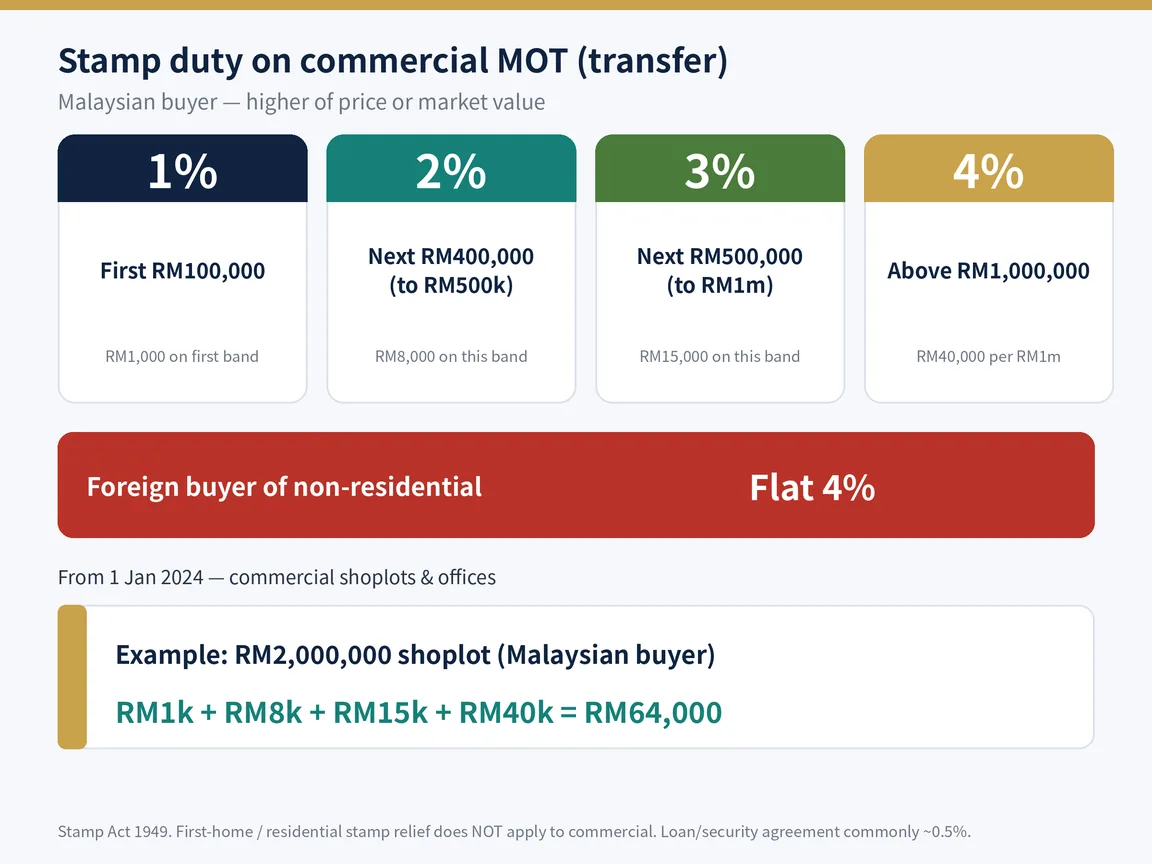
Worked example (Malaysian buyer, RM2,000,000 shoplot): RM1,000 on the first RM100k + RM8,000 on the next RM400k + RM15,000 on the next RM500k + RM40,000 on the remaining RM1,000,000 = RM64,000 transfer duty.
3. RPGT rates for a shoplot or office
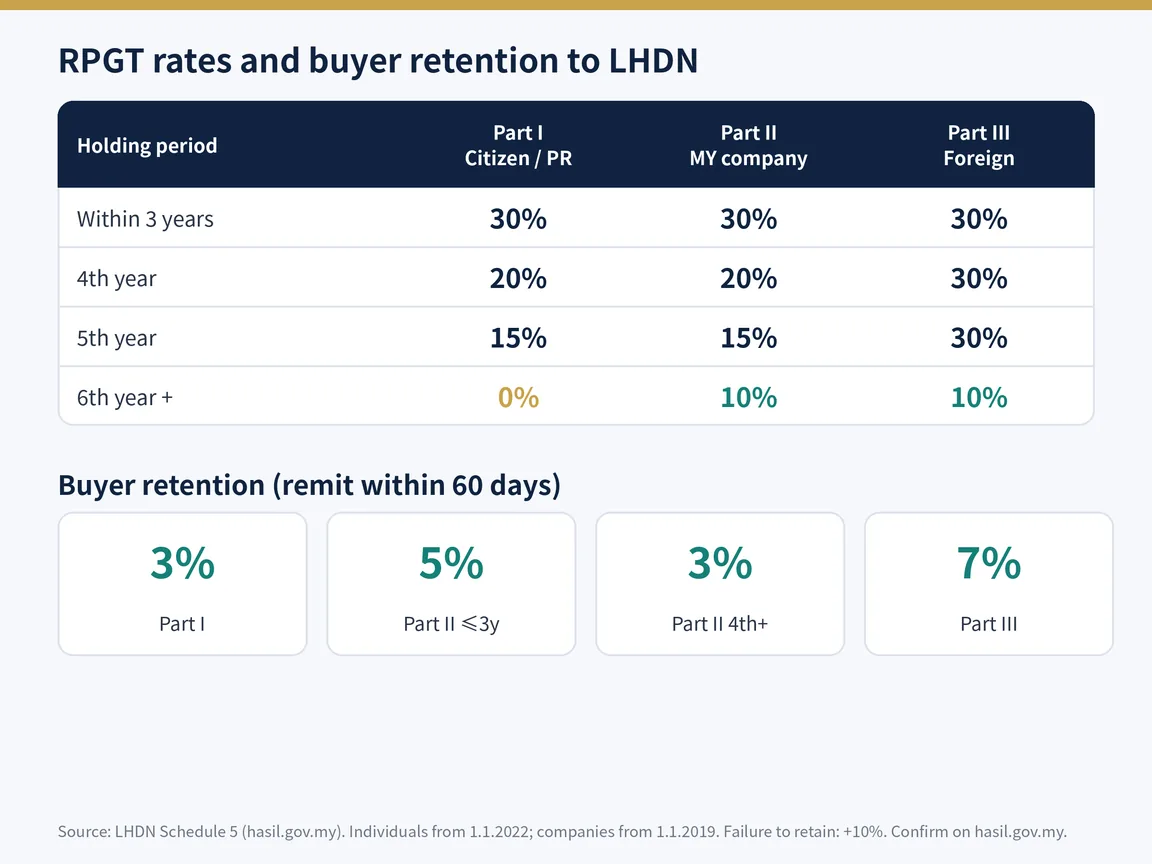
The same Schedule 5 rates cover shoplots, offices, factories and land. The holding period runs from the acquisition date to the disposal date (usually the SPA date). Rates below follow LHDN's Schedule 5 (individuals from 1 January 2022; companies from 1 January 2019), still current as of the LHDN page updated 23 June 2026:
- Part I — citizen / PR individual (and similar): within 3 years 30%; 4th year 20%; 5th year 15%; 6th year onwards 0%.
- Part II — Malaysian company, trustee or body of persons: 30% / 20% / 15% / then 10% from the 6th year. Many shoplots and offices are held in a Sdn Bhd, so this row matters.
- Part III — non-citizen / non-PR / foreign company: 30% for years 1–5; 10% from the 6th year.
The chargeable gain is not simply selling price minus buying price. LHDN allows incidental costs of buying and selling (legal fees, valuation, agent commission, stamp duty paid on purchase) and qualifying capital expenditure that raised or preserved value and is still reflected at sale. Individual sellers then get an exemption of RM10,000 or 10% of the chargeable gain, whichever is higher; companies do not.
4. Buyer retention (pegangan) to LHDN
The acquirer must withhold part of the consideration and remit it to LHDN within 60 days:
- Part I disposer: 3%
- Part II disposer: 5% within 3 years, 3% from the 4th year
- Part III disposer: 7%
Failure attracts a further 10%. The sum is credited against the seller's RPGT; any excess can be refunded after assessment. For YA2026, LHDN also allows remitting the notified deemed assessment amount where applicable — confirm the current option on hasil.gov.my.
5. Filing, stamping and self-assessment
- Disposer and acquirer must notify LHDN and file the CKHT returns (for example CKHT 1A) within the statutory deadlines — typically through e-CKHT on MyTax. Confirm forms and deadlines on hasil.gov.my.
- Stamp the MOT through e-Duti Setem / MyTax. Late stamping attracts penalties.
- Stamp duty self-assessment is phasing in: Phase 1 from 1 January 2026 covers rental, lease, general and securities instruments; property-transfer self-assessment phases in later. Watch LHDN notices for the transfer timeline.
6. Practical tips
- Check the holding period before you sign — waiting a few months into the next year can drop the RPGT rate, especially for individuals moving into the 0% band.
- Agree in the SPA how the retention sum is handled and who files e-CKHT.
- Budget MOT duty (and loan stamp duty if financed) separately from the deposit; commercial deals do not get first-home relief.
- Rates and rules change with each Budget, so confirm the latest position with LHDN or a tax adviser before you commit.
This article is a general guide, not legal or tax advice. Procedures and fees can vary.
Buying or selling a shoplot or office? Chat with PropertyMsia on WhatsApp and we will help you work through the numbers before you sign.
Talk to a registered agent for free advice on pricing, zoning and due diligence.
Get in touch Commercial Listings