Renting a Factory or Warehouse in Malaysia: Tenancy Terms, Stamp Duty and Who Pays What
What to check before you rent a factory or warehouse in Malaysia: tenancy versus lease, power and building specs, who pays quit rent and insurance, stamp duty rates under Item 49, and the 6% service tax on industrial rent.
Updated 5 Nov 2026 · PropertyMsia
In short: renting a factory or warehouse is a business contract, but stamp duty and service tax (SST) are set by law. Check the building specs and the title before you pay a deposit, agree clearly who pays which outgoings, and get the agreement stamped on time.
1. Tenancy or lease?
Under the National Land Code, a term of three years or less is a tenancy. It need not be registered at the land office, though a written agreement is strongly advised. A term of more than three years is a lease: it should be executed in Form 15A and registered. Many deals are written as a two- or three-year term with an option to renew.
2. What to check before you sign
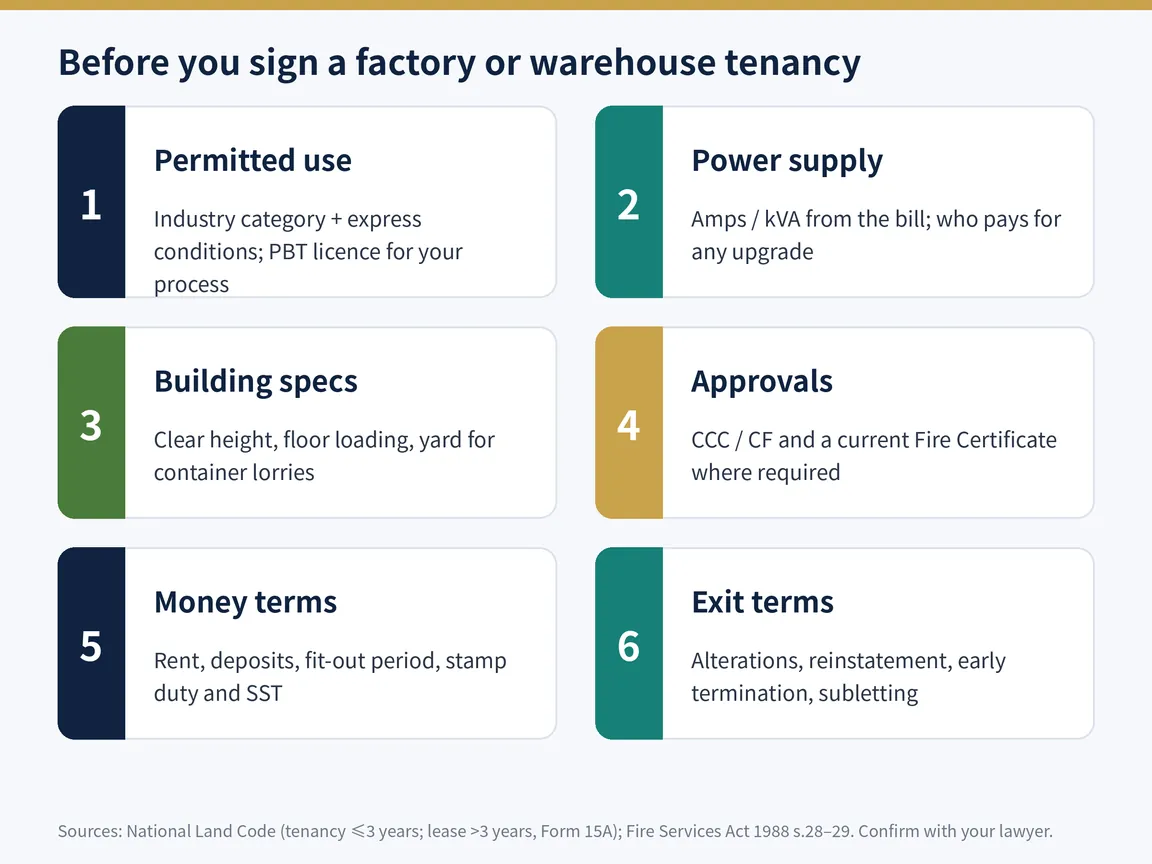
- Permitted use: the land category should be industry and the express conditions must allow your process. Confirm with the local council (PBT) that you can get a business premises licence for that address before you pay any deposit.
- Power supply: record the existing amperage or kVA from the electricity bill, not the advert, and say who pays if you need an upgrade.
- Building specs: clear height, floor loading, office-to-production share, and whether the yard can take container lorries.
- Approvals: ask for the Certificate of Completion and Compliance (CCC) or Certificate of Fitness, and check whether a Fire Certificate under the Fire Services Act 1988 is current for the premises.
- Term, rent and deposits: deposits are negotiable; state when they are refunded and what may be deducted, and agree any rent-free fit-out period in writing.
- Alterations: mezzanines, cranes, new openings and racking usually need landlord consent and often council or Bomba approval. Say what must be removed when you leave.
3. Who pays what
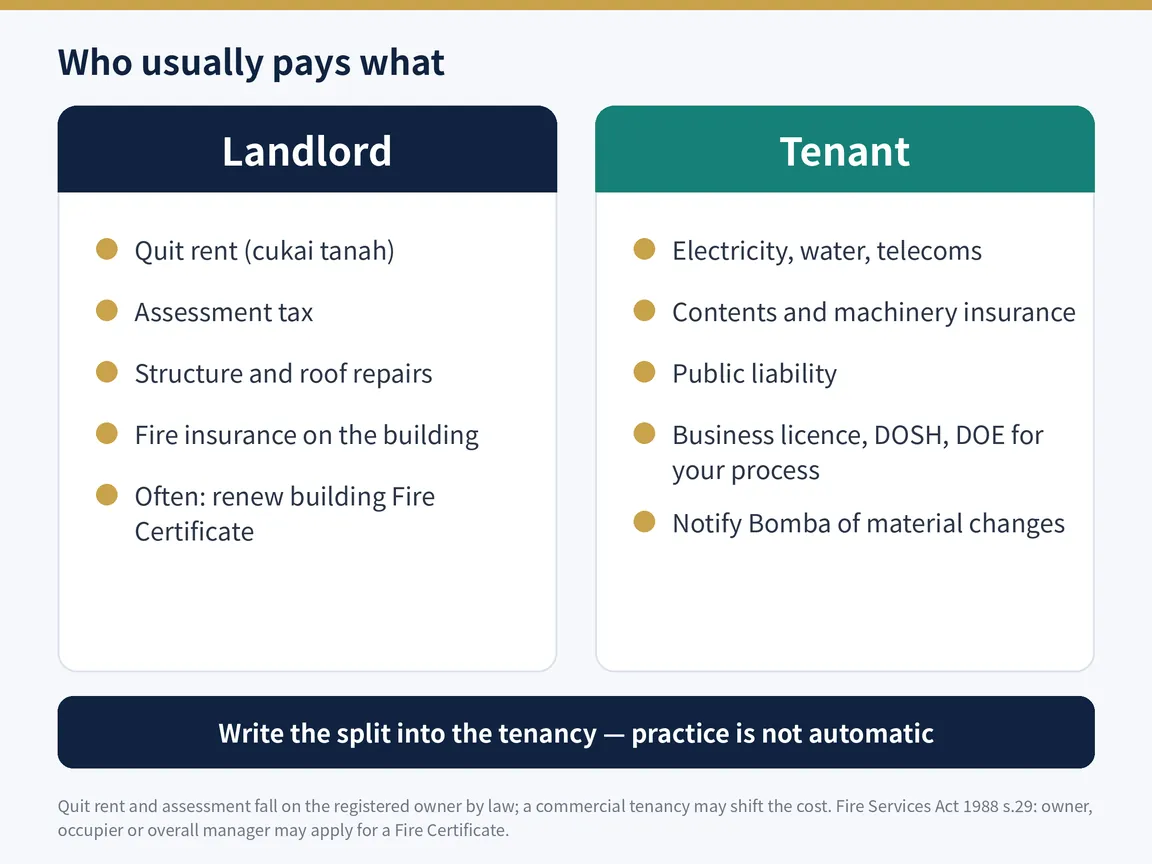
The law puts quit rent and assessment on the registered owner, but a commercial tenancy can shift the cost. Typical practice, which you should still write into the agreement:
- Landlord: quit rent, assessment tax, structural and roof repairs, and fire insurance on the building.
- Tenant: electricity, water, telecoms, contents and machinery insurance, public liability, and the business licences, DOSH and DOE approvals for your own operations.
- Fire certificate and systems: the Fire Services Act lets the owner, occupier or overall manager apply. Many leases leave building Fire Certificate renewal with the landlord, and require the tenant to notify Bomba of material changes and keep sprinklers clear.
4. Stamp duty on the tenancy agreement
Under Item 49(a) of the First Schedule to the Stamp Act 1949 (as updated by the Finance Act 2024 from 1 January 2025), duty is charged on every RM250, or part of RM250, of the average annual rent and other consideration. The old exemption on the first RM2,400 of annual rent was removed. LHDN's guideline (30 June 2026) confirms the rates:
- Term up to 1 year: RM1 per RM250
- More than 1 year up to 3 years: RM3 per RM250
- More than 3 years up to 5 years: RM5 per RM250
- More than 5 years: RM7 per RM250
The tenant is liable for duty on the original; the landlord for each duplicate (RM10). A premium or key money is charged separately under Item 49(b)/(c). Stamp through e-Duti Setem on MyTax within 30 days of signing. An unstamped agreement cannot be used in court until the duty and any penalty are paid.
Example: a warehouse at RM15,000 a month has an annual rent of RM180,000 (720 units of RM250). Duty is RM720 for a one-year term, RM2,160 for a two- or three-year term, RM3,600 for more than three up to five years, and RM5,040 above five years.
5. Service tax (SST) on industrial rent
Rental and leasing of factories and warehouses is a taxable service. The rate is 6% from 1 January 2026 (it was 8% from July to December 2025). Homes rented for living are outside the charge. Refundable security deposits are not taxed. Landlords whose taxable rental income exceeds the Customs threshold must register and charge SST. SME tenants with annual sales of up to RM1.5 million can be exempt if they register and declare in Customs' MyPMK system; newly established MSMEs are exempt for their first year from SSM registration.
6. Practical tips
- Do a land search and confirm the signatory is the registered owner, or that a sub-landlord has written consent to sublet.
- Ask whether the landlord is SST-registered, and state in the agreement whether the rent includes SST.
- Write down who pays stamp duty, legal fees, power upgrades and Fire Certificate renewals.
- Tax and land rules can change with each Budget, so confirm the latest position with LHDN, Customs or your lawyer before you sign.
This article is a general guide, not legal advice. Procedures and fees vary by state.
Looking for a factory or warehouse to rent? Chat with PropertyMsia on WhatsApp and we will help you compare units and understand the costs before you sign.
Talk to a registered agent for free advice on pricing, zoning and due diligence.
Get in touch Industrial Listings