Industrial Building Allowance (IBA) in Malaysia: Tax Deductions for Factory and Warehouse Owners
How Industrial Building Allowance works for factory and warehouse owners in Malaysia: which buildings qualify under Schedule 3 of the Income Tax Act 1967, the 10% initial and 3% annual rates, why land is never claimable, how landlords and tenants claim, what happens when you sell, and the records to keep.
Updated 14 Nov 2026 · PropertyMsia
In short: Land cannot be depreciated for tax, but the building on it can. If you own a factory, or certain kinds of warehouse, used in a business, Schedule 3 of the Income Tax Act 1967 lets you deduct its cost through Industrial Building Allowance (IBA): generally a 10% initial allowance in the first year plus a 3% annual allowance every year, on the building cost only. When you later sell, the tax already claimed is squared up through a balancing allowance or balancing charge.
1. What counts as an industrial building
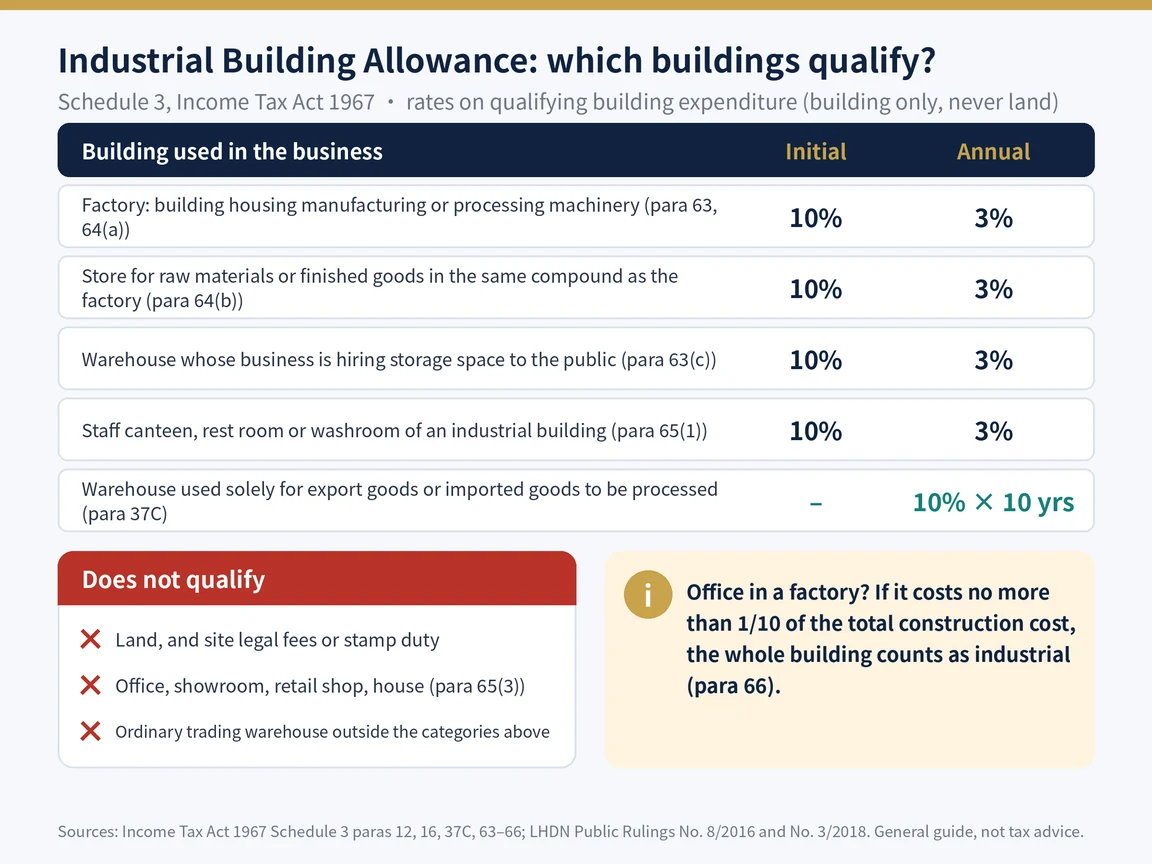
Paragraph 63 of Schedule 3 lists buildings used for a business as a factory, a dock, wharf or jetty, a warehouse whose business is hiring storage space to the public, a public water, electricity or telecommunication undertaking, or a farm or mine. Under Public Ruling No. 8/2016, a factory includes a building housing manufacturing or processing machinery.
A store for raw materials, fuel or finished goods qualifies only if it sits within the same compound (curtilage) as the factory. Staff canteens, rest rooms and washrooms serving an industrial building also qualify. A warehouse used solely to store goods for export, or imported goods to be processed and distributed or re-exported, is treated as an industrial building under paragraph 37C, with a faster 10% annual allowance for ten years and no initial allowance.
A dwelling house, retail shop, showroom or office is not an industrial building (paragraph 65(3)). However, if the non-industrial part of a building, such as an attached office block, costs no more than one-tenth of the total construction cost, the whole building is treated as industrial (paragraph 66). An ordinary trading warehouse outside these categories generally does not qualify.
2. The rates
For a factory and other paragraph 63 buildings, the initial allowance is one-tenth of the qualifying building expenditure (paragraph 12) and the annual allowance is three-hundredths a year (paragraph 16). Year one therefore gives 13%, and the cost is fully written off after 30 years of assessment. The annual allowance is given only if, at the end of the basis period, you own the building and it is in use as an industrial building. A temporarily idle factory kept ready for use still counts.
3. Qualifying building expenditure: building yes, land no
If you build, qualifying cost covers construction, piling, architect and approval fees, built-in wiring, and capital additions or renovations. Routine repairs are not IBA, though they may be deductible as a business expense. Land cost and the legal fees, stamp duty and surveyor fees for acquiring the site are excluded.
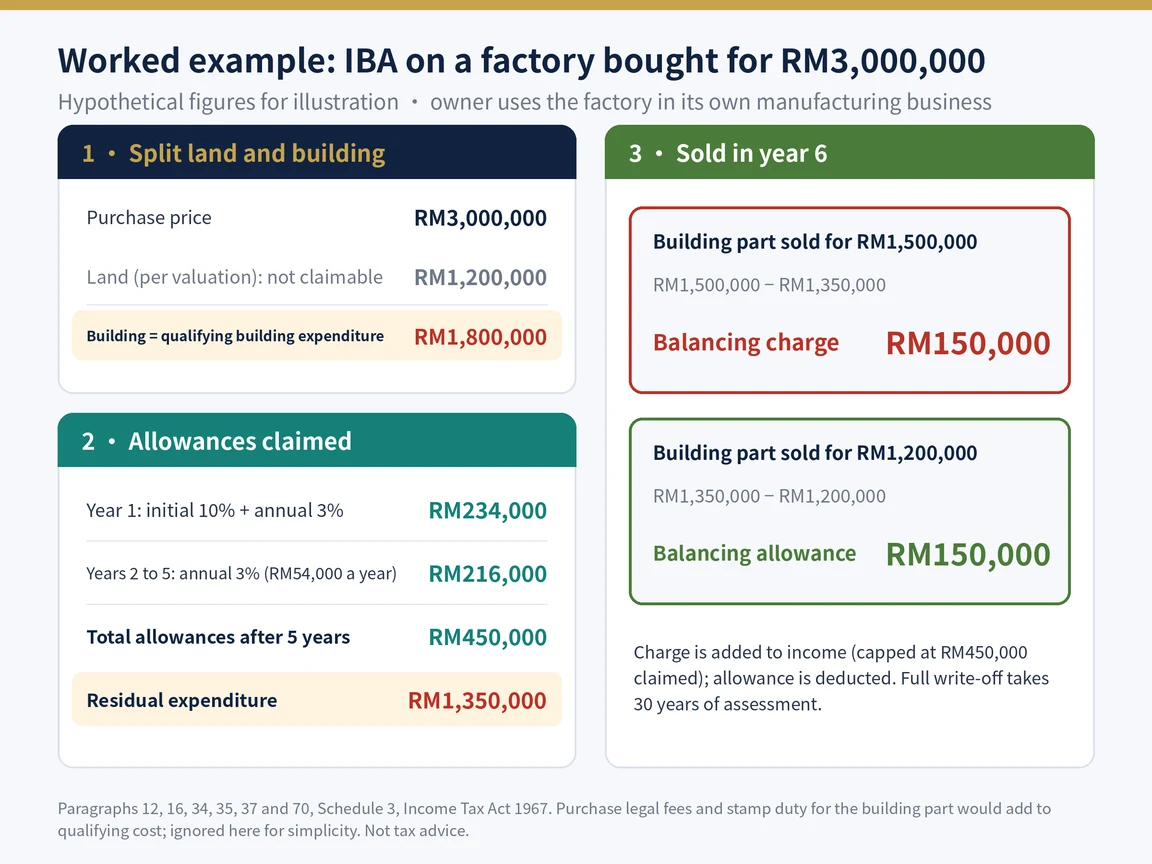
If you buy, the qualifying cost is the purchase price of the building, plus the legal fees, stamp duty and other incidental costs that relate to the building, but never the land (paragraph 70). New and second-hand buildings are treated the same. Where the SPA gives a single price, Public Ruling No. 3/2018 expects you to get a valuation from JPPH (the Valuation and Property Services Department) or a registered valuer to split land and building; see our guide to how factories are valued. Machinery and items such as air-conditioning are claimed separately as plant and machinery, not as IBA.
4. Who can claim: owners, landlords and tenants
The claimant must own the building and incur the expenditure. An owner-occupier claims against its business income. A landlord who leases a building that the tenant uses as an industrial building, for example a factory let to a manufacturer, can also claim IBA against the rental income (paragraph 60). For special categories such as paragraph 37C warehouses bought or built from year of assessment 2016, only an owner who runs the business itself may claim. A tenant cannot claim on the landlord’s building, but can claim IBA on its own additions or renovations, which must be clearly identifiable from the original building.
5. Selling the building: balancing allowance or charge
On disposal, the building’s residual expenditure (cost less all allowances given) is compared with its disposal value, which is the higher of market value or net sale proceeds for the building. If residual expenditure is higher, you get a balancing allowance for the difference (paragraph 34). If the disposal value is higher, a balancing charge is added to your income (paragraph 35), capped at the total allowances you received (paragraph 37). The balancing charge is income tax and is separate from RPGT on the property; see our RPGT and stamp duty guide for factories.
6. Practical tips
- Split land and building in writing. Ask for separate values in the SPA or get a formal valuation at purchase.
- Keep every cost record, including the reasons for any renovation or alteration.
- Watch the office share. Keep it within the one-tenth cost limit; space let out to others can also reduce the qualifying portion.
- Check the use, not the title. A factory turned into a showroom or plain store can stop qualifying.
This guide is general information based on Schedule 3 of the Income Tax Act 1967 and LHDN Public Rulings No. 8/2016, No. 10/2016 and No. 3/2018 as at November 2026. It is not tax advice; ask your tax agent before filing a claim.
Buying, building or selling a factory or warehouse? Chat with PropertyMsia on WhatsApp and we will help you find the right property and connect you with the right professionals.
Talk to a registered agent for free advice on pricing, zoning and due diligence.
Get in touch Industrial Listings