How Land Is Valued in Malaysia: Valuation Methods, JPPH Data and What Affects the Price
A plain-English guide for land buyers and owners: who may value land, how the comparison and residual methods work, how to use JPPH and NAPIC data, the title, planning and site factors that move the price, and how valuation affects stamp duty and financing.
Updated 28 Nov 2026 · PropertyMsia
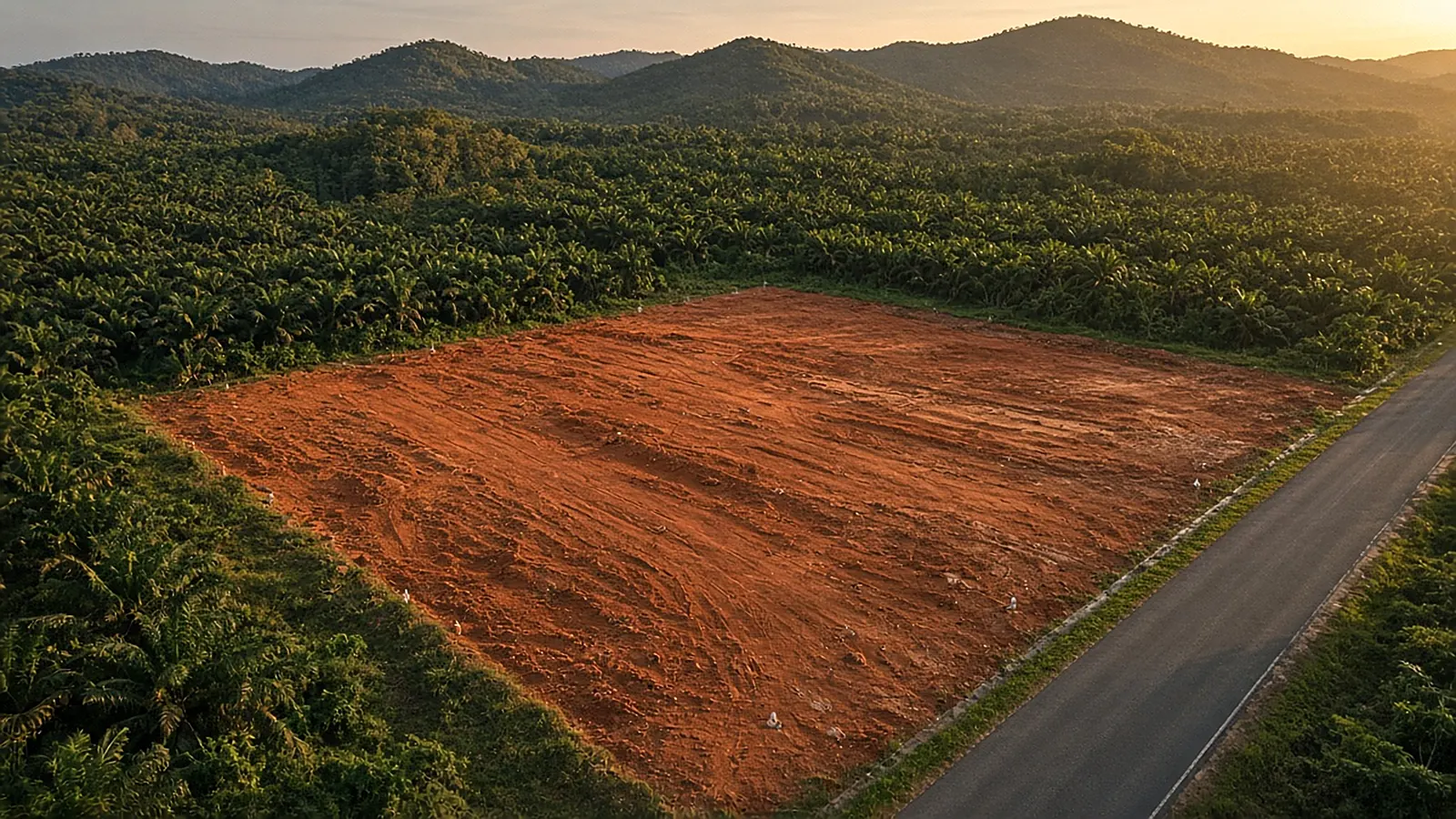
In short: A piece of land is worth what a willing buyer would pay a willing seller today, and in Malaysia that opinion should come from a registered valuer. For most land the valuer compares recent sales nearby. For development land they also work backwards from what could be built. The title, the local plan, road access and any registered interests can move the figure a lot, and the same market value sets your stamp duty. This is general information for Peninsular Malaysia, not valuation or legal advice.
1. Who can value land
Under section 19 of the Valuers, Appraisers, Estate Agents and Property Managers Act 1981 (Act 242), a registered valuer holding an authority to practise from the Board (BOVAEP, or LPPEH) may value land and buildings, including trees and crops. Section 21 bars anyone else from doing this for a fee. You will usually meet three valuers:
- Your own valuer, before you buy, sell or settle a dispute.
- The lender's valuer, for your loan.
- JPPH (Valuation and Property Services Department), the government valuer that assesses market value for stamp duty on a transfer.
An estate agent can share market views, but a formal valuation report must come from a registered valuer.
2. The comparison method
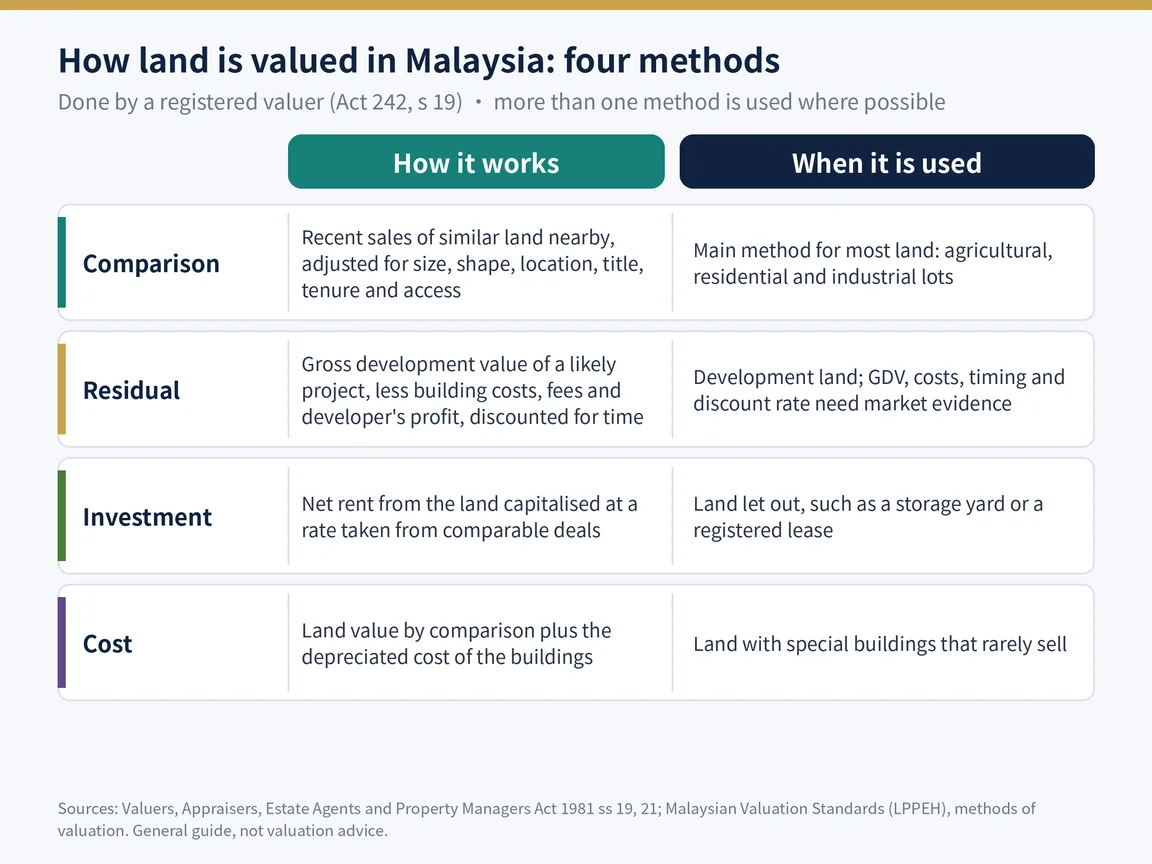
This is the main method for most land. The valuer picks recent sales of similar land nearby, then adjusts each one for differences such as size, shape, location, category of land use, tenure and access, to reach a rate per square foot or acre. The Malaysian Valuation Standards ask valuers to show the comparables in the report, so read them, not just the final figure.
3. The residual method for development land
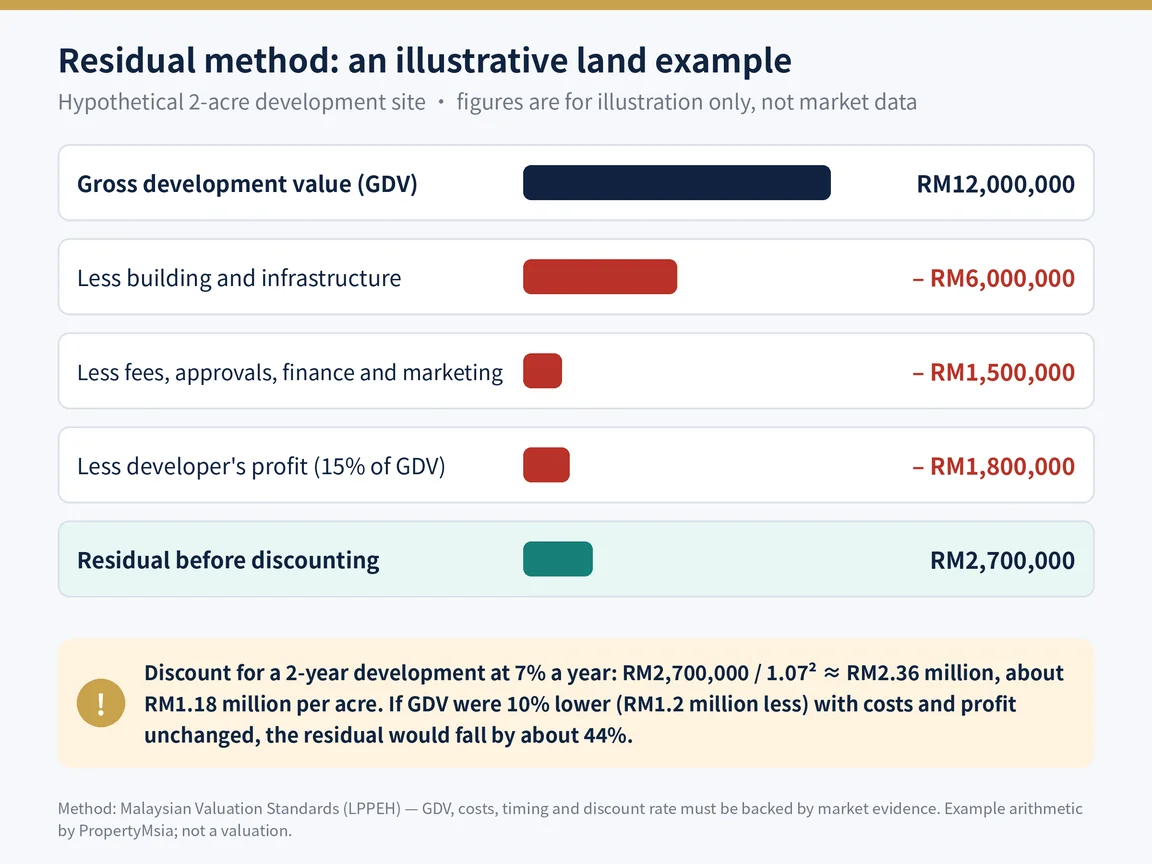
For land ripe for development, the valuer also asks what a developer could pay. They estimate the gross development value (GDV) of a project the planning rules would allow, deduct building and infrastructure costs, fees, approvals, finance and a developer's profit, and discount what is left for the development period. The standards require the GDV, costs, timing and discount rate to be backed by market evidence. Land value is a small difference between two big numbers, so small changes in prices or costs move it sharply.
Where land is let out, for example as a storage yard, the investment method capitalises the net rent. For land with special buildings, the cost method adds the depreciated cost of the buildings to the land value, as in our factory valuation guide.
4. What moves the price of land
- Category of land use and conditions: agriculture, building or industry (National Land Code s 52), plus express conditions and restrictions in interest on the title. See understanding land titles.
- Tenure: freehold or leasehold of up to 99 years. Value usually falls as the remaining lease gets shorter; see extending a leasehold title.
- Zoning in the local plan: under section 18 of the Town and Country Planning Act 1976, land may only be used in line with the local plan, so zoning and the chance of conversion matter.
- Access and frontage: a legal road frontage is worth far more than a track over a neighbour's land; see land without road access.
- Size, shape and terrain: regular, level plots are easier to build on; very large plots often fetch a lower rate per square foot.
- Flood risk and drainage: low-lying land may need filling and drains.
- Malay reserve: fewer eligible buyers usually means a lower price.
- Encumbrances: charges, caveats, registered leases and easements. A current official search shows them.
5. Using JPPH and NAPIC data
NAPIC, part of JPPH, publishes free Open Sales Data on residential, commercial and industrial transactions. For agricultural and development land, its yearly Property Market Report shows the trend: in 2025 it recorded 76,656 agriculture transactions worth RM17.78 billion and 27,686 development land and other transactions worth RM23.32 billion. Use them for context; for close comparables, ask a valuer.
6. Stamp duty: JPPH's market value
Duty on a land transfer is charged on the price or the market value, whichever is higher. The Stamp Office asks JPPH for the market value as at the date of the sale agreement, and JPPH aims to report within five working days for non-standard cases such as most land. If you disagree, object in writing within 30 days of the assessment under section 38A of the Stamp Act 1949, ideally with a valuer's report; the duty remains payable. A further appeal goes to the High Court within 21 days of the decision. See our land due diligence checklist for the other costs.
7. Loan valuation and market value
A lender's valuation is still an opinion of market value, but it is made for the lender, which commonly finances against the lower of price and valuation. If it comes in below your price, you need more cash. Ask for a valuation before you sign, not after.
8. Practical tips
- Check that the valuer is on the Board's register.
- Give them the title, a current official search, the certified plan and any planning approvals.
- Compare like with like: same category, tenure and access.
Sources: Act 242, the National Land Code, the Town and Country Planning Act 1976, the Stamp Act 1949, LHDN, JPPH and NAPIC (November 2026).
Buying or selling land and unsure of its value? Chat with PropertyMsia on WhatsApp and we will help you check the details before you commit.
Talk to a registered agent for free advice on pricing, zoning and due diligence.
Get in touch Land Listings