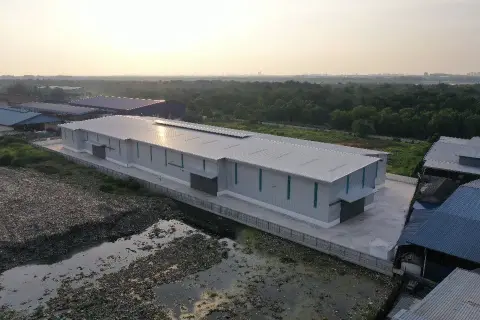
Free Industrial Zones and LMW Status in Malaysia: What Factory Buyers and Tenants Should Know
How Malaysia's Free Industrial Zones (FIZ) and Licensed Manufacturing Warehouses (LMW) work for export manufacturers: the laws behind them, who qualifies, how duty is treated, what happens to local sales, and the property checks to make before you buy or rent a factory for an FIZ or LMW operation.
Updated 11 Nov 2026 · PropertyMsia
In short: Export manufacturers in Malaysia can import raw materials, components and machinery with customs duty relief in two main ways: by operating inside a Free Industrial Zone (FIZ), or by holding a Licensed Manufacturing Warehouse (LMW) licence for a factory elsewhere. Both are tied to the premises, so the factory you buy or rent matters. Choose the wrong building and the licence can be delayed or refused.
1. What a free zone is
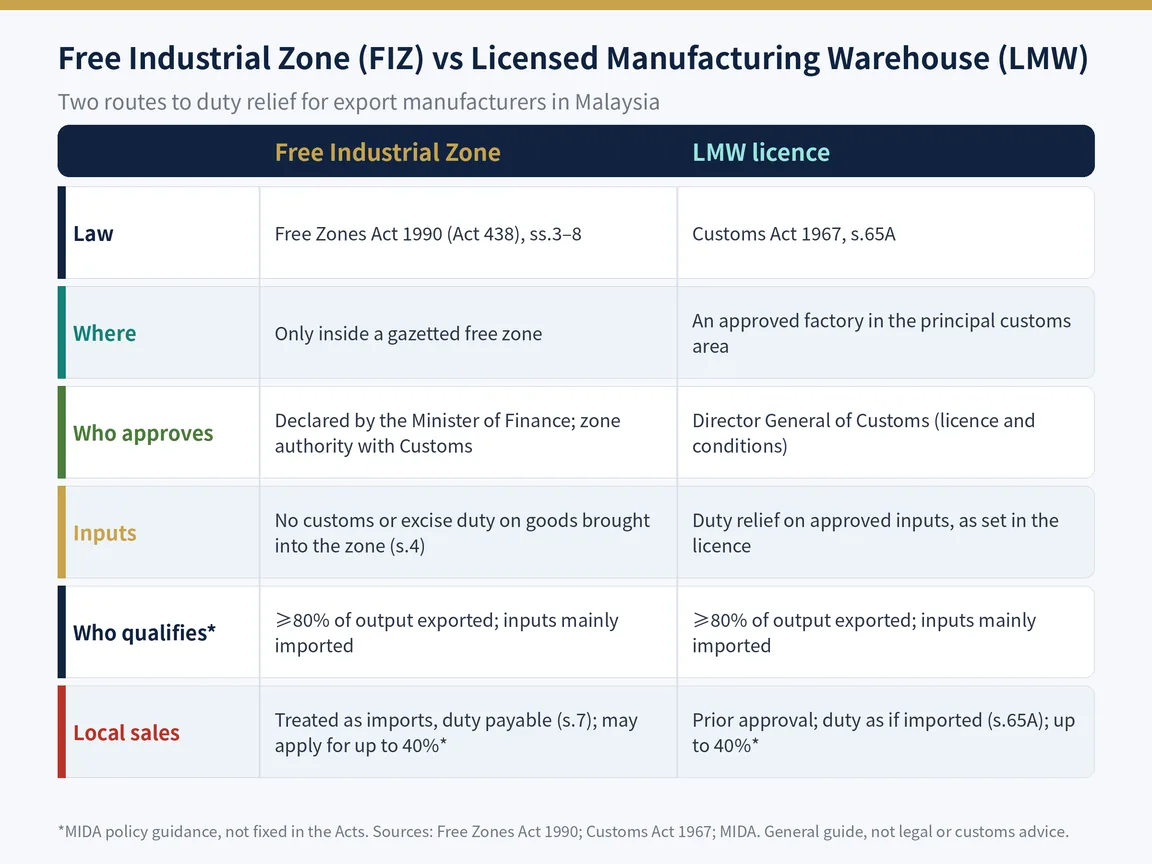
Under section 3 of the Free Zones Act 1990 (Act 438), the Minister of Finance may declare an area a free commercial zone or a free industrial zone. FIZs are meant for manufacturers that produce or assemble mainly for export. Under section 4, goods may be brought into, produced or manufactured in a free zone without paying customs duty or excise duty, except goods that are absolutely prohibited.
A free zone sits outside the “principal customs area”. Goods moved from the rest of Malaysia into a free zone are treated as exported, and goods taken out of the zone into the rest of Malaysia are treated as imported, with any duty payable (section 7). Goods manufactured in an FIZ may leave only for export, or to a free commercial zone with approval (section 8).
MIDA’s published list of FIZs includes zones at Pasir Gudang, Tanjung Pelepas, Batu Berendam, Tanjung Kling, Telok Panglima Garang, Pulau Indah (Port Klang Free Zone), Sungai Way, Ulu Kelang, Jelapang, Kinta, Bayan Lepas, Seberang Perai and Sama Jaya. Zones are added or changed by gazette, so check the current list with the Royal Malaysian Customs Department.
2. What an LMW is
Where setting up in an FIZ is not practical, a company can apply for an LMW licence under section 65A of the Customs Act 1967. The Director General of Customs may license a person to carry on manufacturing and other operations on goods, for a period and on the conditions stated in the licence. MIDA describes the facilities given to LMWs as similar to those for FIZ factories. The big difference for property: an LMW can be an ordinary factory in an ordinary industrial park, but only once Customs has approved those premises.
3. Who usually qualifies
According to MIDA, companies are normally approved for an FIZ or an LMW when:
- their entire production, or not less than 80% of it, is meant for export; and
- their raw materials and components are mainly imported (the Government still encourages local sourcing).
The 80% figure is a policy benchmark, not a number written into the Act. The actual conditions are set in each licence.
4. Selling in Malaysia
Local sales are possible but controlled. Under section 65A, goods made in an LMW cannot be released for home consumption or export without the Director General’s prior approval. If they are released for home consumption, duty is calculated as if the goods had been imported. MIDA notes that FIZ and LMW companies may apply for approval to sell up to 40% of their production in the domestic market if they meet the criteria. If your business plan relies heavily on local customers, an FIZ or LMW may not suit you.
5. Property checks before you buy or rent
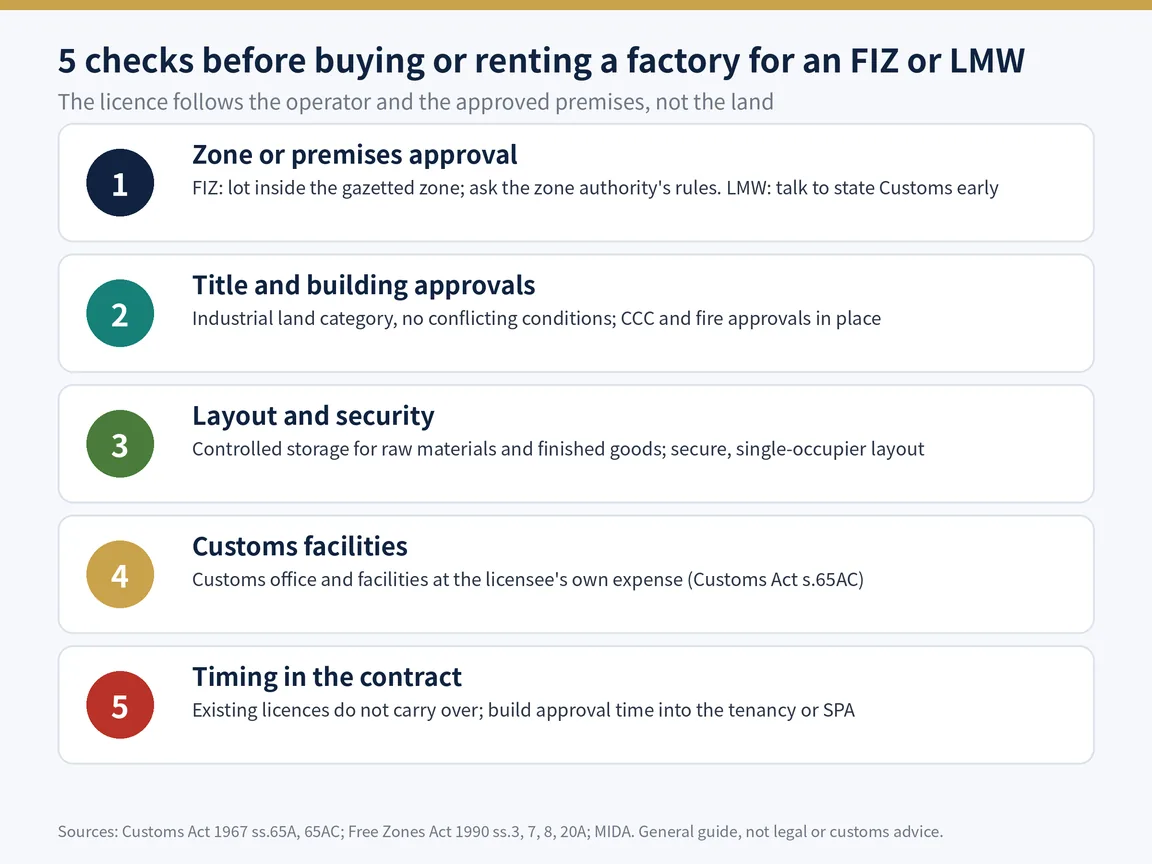
- Zone or premises approval: for an FIZ, confirm the lot is inside the gazetted zone and ask the zone authority about its rules for occupying, leasing or transferring premises. For an LMW, speak to the state Customs office early about whether the building is likely to be accepted.
- Title and building approvals: the land should be in the industrial category with no conflicting express conditions, and the building should have its Certificate of Completion and Compliance (CCC) and fire approvals. See our guides on industrial land titles and factory compliance.
- Layout and security: bonded raw materials, finished goods and other stock need to be controlled and recorded. A factory with a clear, single-occupier layout and secure boundary is easier to work with than a shared or subdivided building.
- Customs facilities: under section 65AC, a licensed warehouse licensee must provide a suitable customs office and facilities within or at the perimeter of the premises at its own expense. Senior customs officers also have full access to premises in a free zone (Free Zones Act, section 20A).
- Timing: licences are granted to an operator for approved premises, not to the land, so a new owner or tenant should not assume an existing licence carries over. Build the approval period into your tenancy or SPA, for example through a conditions-precedent clause.
6. For landlords and sellers
A factory that already suits export manufacturers, with an approved layout, a clean CCC and a secure perimeter, can appeal to more buyers and tenants. State the zone status accurately in your listing and keep plans and approvals ready for due diligence.
This guide is general information based on the Free Zones Act 1990, the Customs Act 1967 and MIDA’s published guidance. It is not legal, tax or customs advice. Confirm the latest requirements with the Royal Malaysian Customs Department and MIDA before you commit.
Looking for a factory for an export or LMW operation? Chat with PropertyMsia on WhatsApp and we will help you shortlist suitable industrial properties.
Talk to a registered agent for free advice on pricing, zoning and due diligence.
Get in touch Industrial Listings