
Due Diligence Checklist Before Buying a Shoplot or Office in Malaysia
A practical checklist for buyers of shoplots and offices in Malaysia: what the official land search tells you, land use conditions and restrictions, CCC and approved plans, unpaid quit rent, assessment and maintenance fee, the RPGT retention sum, and how existing tenancies and the seller's status affect your purchase.
Updated 15 Nov 2026 · PropertyMsia

In short: Most expensive surprises in a shoplot or office purchase can be found before you sign: a title condition that does not suit your business, an extension that was never approved, unpaid bills that come with the unit, or a tenant you cannot remove. Check four things before you commit: the title, the building, the money owed and the people involved. Your lawyer handles the formal searches, but knowing what to ask saves time and money.
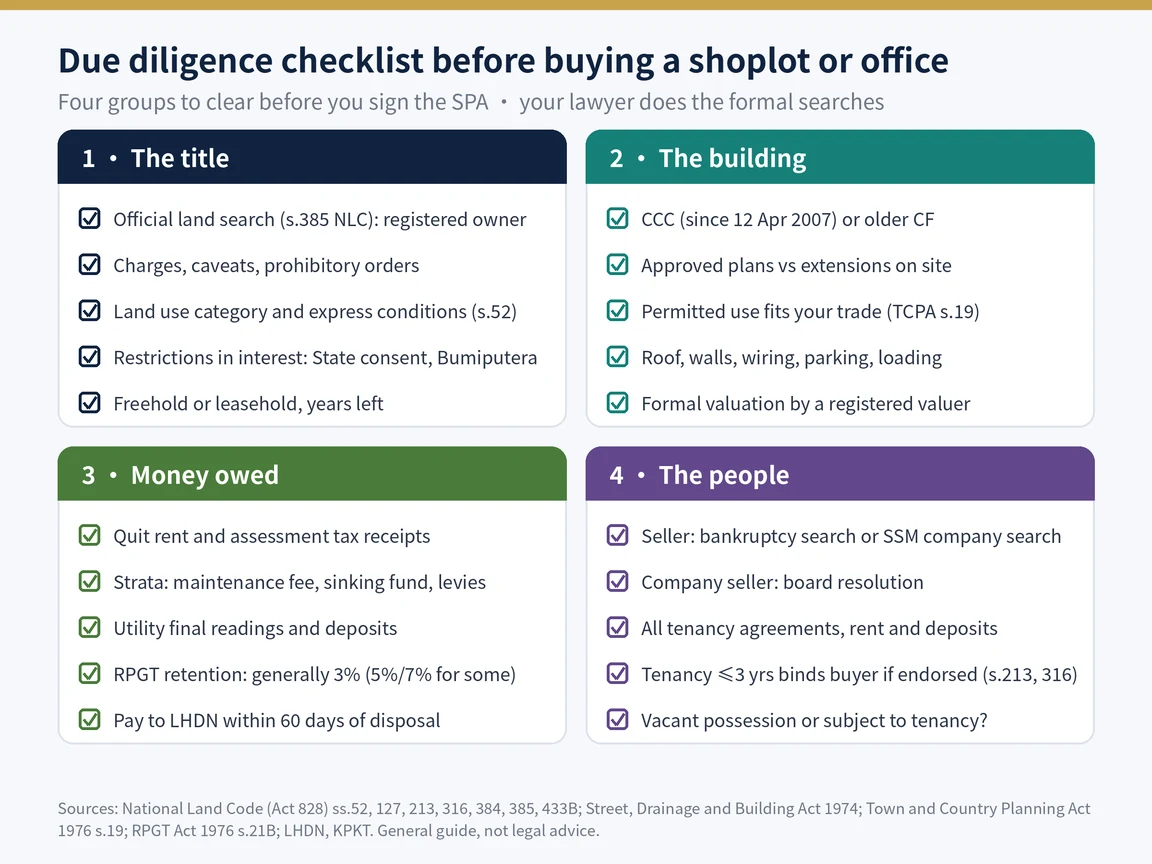
1. The title
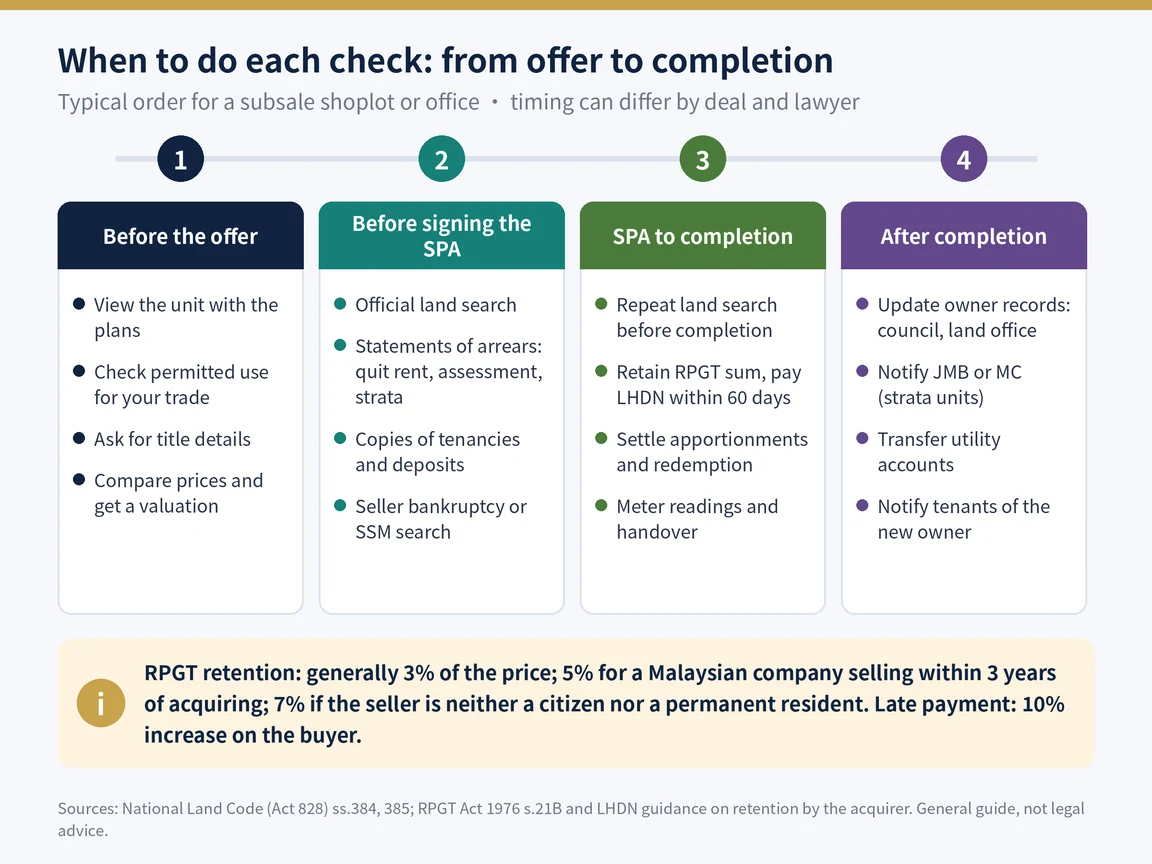
Start with an official land search (carian rasmi) under section 385 of the National Land Code. The Registrar issues a certificate showing the registered owner, the express conditions and restrictions in interest, existing entries such as charges and caveats, and whether any dealing or prohibitory order has been presented. A private search under section 384 is quicker but comes without a certificate. Lawyers usually search before the SPA and again just before completion.
- Owner: the seller should be the registered owner, or be properly authorised to sell.
- Charges and caveats: an existing charge is normally redeemed from your purchase price; a private caveat or lien-holder’s caveat must be explained and removed before transfer.
- Category and express conditions: the Code has three categories of land use: agriculture, building and industry (section 52). A commercial lot is normally “building” with an express condition for commercial use. A breach of a condition can make the land liable to forfeiture or a fine (section 127).
- Restrictions in interest: some titles need State consent to transfer or are reserved for Bumiputera buyers. A non-citizen or foreign company needs prior State approval (section 433B).
- Tenure: for leasehold, note the years left; a short remaining lease can affect financing and resale.
2. The building and its permitted use
- CCC or CF: buildings completed under the system in force since 12 April 2007 have a Certificate of Completion and Compliance issued by the principal submitting person (a registered architect, professional engineer or building draughtsman), not the council. Older buildings have a Certificate of Fitness. Ask for a copy.
- Approved plans versus the site: back extensions, added mezzanines and removed walls are common in older shoplots. Compare what you see with the approved building plans. Unapproved works can attract council action, and the new owner inherits the problem.
- Permitted use: under the Town and Country Planning Act 1976, a material change in the use of a building is “development” that needs planning permission (section 19). Check that your planned trade fits the approved use of the unit and floor before you rely on getting a council business licence.
- Condition and value: inspect the roof, walls, wiring, water, toilets, parking and loading access, and get a formal valuation from a registered valuer.
For strata units, see also our guide to strata shops and offices.
3. The money owed on the unit
- Quit rent and assessment tax: ask for the latest paid receipts. The SPA usually apportions these at completion, and your lawyer checks for arrears.
- Maintenance fee and sinking fund: for strata units, get a written statement from the JMB or MC showing what has been paid and any special levy, plus the latest budget and AGM minutes.
- Utilities: arrange final readings and the transfer of accounts and deposits.
- RPGT retention: under section 21B of the Real Property Gains Tax Act 1976, the buyer must retain part of the price and pay it to LHDN within 60 days of the disposal date: generally 3%, but 5% for a Malaysian company selling within three years of acquiring the property and 7% for a seller who is neither a citizen nor a permanent resident. If the buyer fails to pay, an increase of 10% is imposed on the buyer. See our RPGT and stamp duty guide for shoplots and offices.
4. The seller and any tenants
- Seller: for an individual, a bankruptcy search with the Malaysian Department of Insolvency; for a company, an SSM search and a board resolution approving the sale.
- Tenants: get every tenancy agreement, with the rent, deposits, expiry date and any renewal option. A tenancy of up to three years is exempt from registration (section 213) and binds a buyer only if it has been endorsed on the title (section 316); a lease of more than three years is registered on the title. In practice, the SPA should say clearly whether the sale is with vacant possession or subject to tenancy, and how deposits are handed over.
5. Practical tips
- Search early. Ask for the title details at the offer stage so problems surface before deposits are paid.
- Put conditions in writing. Where you can, agree that the earnest deposit is refundable if the searches reveal a defect.
- Walk the site with the plans. Extensions are easy to spot there and costly to fix later.
- Budget the full cost: stamp duty, legal fees, valuation and any repairs, not just the price.
This guide is general information based on the National Land Code (Act 828), the Street, Drainage and Building Act 1974, the Town and Country Planning Act 1976 and the Real Property Gains Tax Act 1976, with LHDN and KPKT published material as at November 2026. It is not legal advice; appoint a lawyer to carry out the searches for your purchase.
Looking for a shoplot or office to buy? Chat with PropertyMsia on WhatsApp and we will help you shortlist suitable commercial properties.
Talk to a registered agent for free advice on pricing, zoning and due diligence.
Get in touch Commercial Listings