
Tenant Not Paying Rent on a Shoplot or Office in Malaysia: Distress, Notices and Recovering Possession
What a shoplot or office owner in Peninsular Malaysia can lawfully do when a tenant stops paying rent: why self-help such as changing locks is not allowed, how a court warrant of distress for up to 12 months' rent works, which goods cannot be seized, ending the tenancy, double rent for holding over, and getting the unit back through the court.
Updated 21 Nov 2026 · PropertyMsia

A good commercial tenant pays on time for years. But when a shop or office tenant falls behind, many owners are tempted to change the locks or switch off the power. In Malaysia that is the wrong move. The law gives owners clear tools to recover rent and the unit, but they all go through the court. This guide covers Peninsular Malaysia, where the Distress Act 1951, the Specific Relief Act 1950 and the Civil Law Act 1956 apply. It is general information, not legal advice.
Summary
- Do not lock out the tenant, cut water or electricity, or take their goods yourself.
- For arrears, you can ask the court for a warrant of distress covering up to 12 completed months of rent.
- To get the unit back after the tenancy ends, you must go through court proceedings.
- A tenant who stays on after the tenancy ends can be charged double rent, at the owner's option.
1. Start with your paperwork
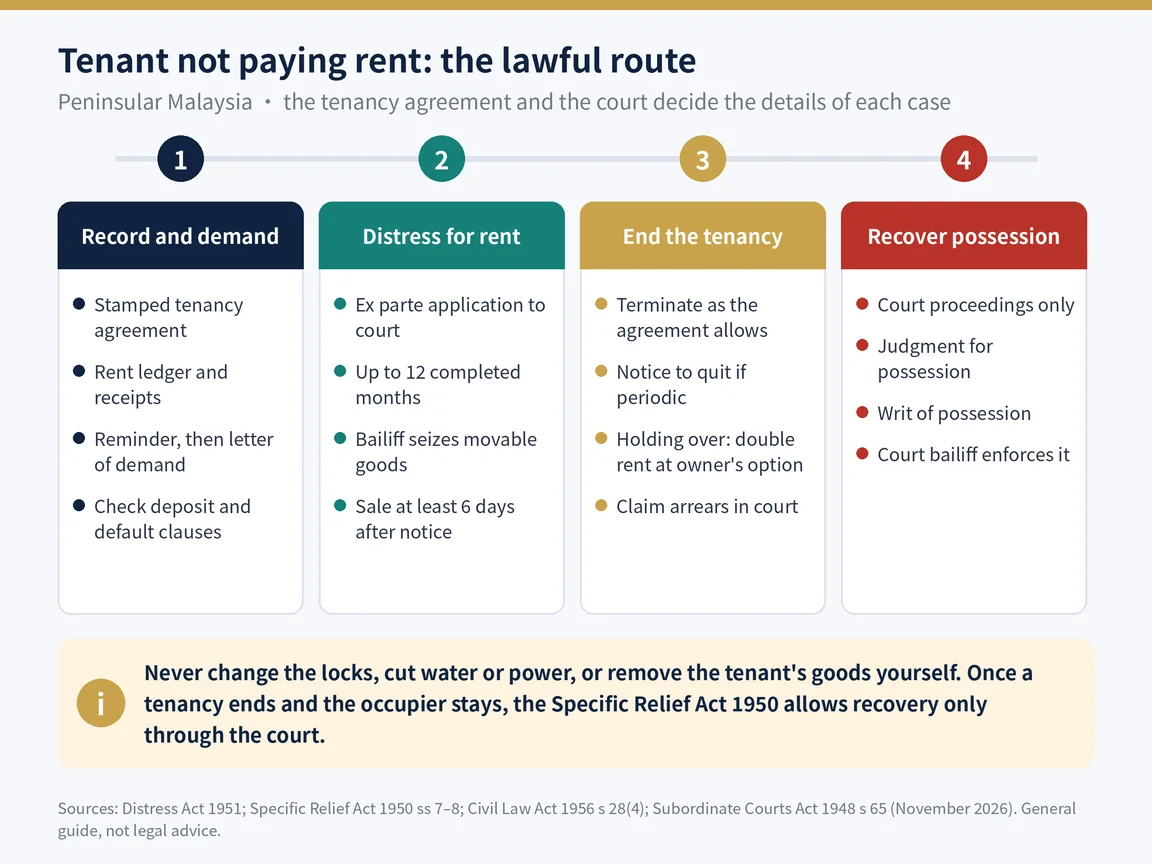
Everything later depends on your records. Keep the signed and stamped tenancy agreement, a rent ledger with receipts and bank records, and copies of every reminder. An unstamped agreement has to be stamped, with any penalty, before a court will accept it as evidence. Read the clauses on default, interest, termination and how the security deposit may be used. Send a written reminder first, then a formal letter of demand. Many cases settle at this stage with a payment plan in writing.
2. No self-help: why you cannot just lock up
Section 7(2) of the Specific Relief Act 1950 says that when a tenancy has ended but the occupier stays on, the owner shall not recover the property otherwise than by proceedings in the court. Section 8 lets a person who is put out without consent, other than in due course of law, sue to recover possession. The Distress Act 1951 adds that no landlord may distrain for rent except as that Act provides. So changing locks, cutting utilities or removing goods can expose the owner to a claim, even when rent is owed.
3. Distress for rent: recovering arrears
Distress lets an owner recover unpaid rent from the tenant's goods on the premises, through the court:
- The landlord, or an agent with written authority, applies ex parte to the court for a warrant of distress for rent of up to 12 completed months immediately before the application. The Sessions Court has unlimited jurisdiction over landlord and tenant matters and distress.
- A bailiff, not the owner, seizes movable property on the premises. The court may ask the owner to deposit the bailiff's fees and expenses first.
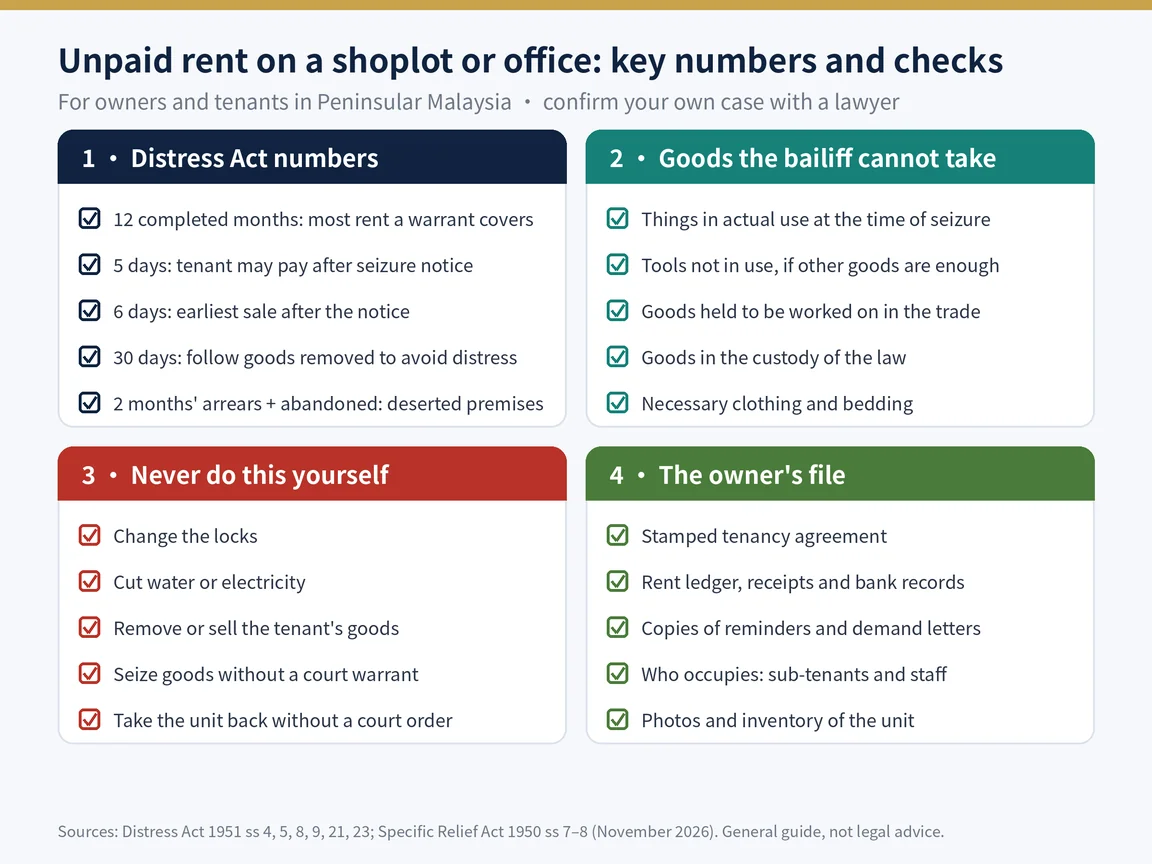
- The bailiff lists and values the goods and gives notice. The tenant may pay within 5 days, and the sale cannot be less than 6 days after the notice. Sale money goes to the bailiff's fees first, then rent and costs; any balance returns to the tenant.
- Some goods cannot be seized, such as things in actual use, tools not in use if other goods are enough, and goods held to be worked on in the tenant's trade.
- If goods are moved out to avoid distress, a judge may let the bailiff follow and seize them within 30 days.
- Where there is a sub-tenant, the owner may, by registered post, require the sub-tenant to pay rent directly until the arrears are cleared.
The tenant can apply to court to discharge or suspend the warrant, so the claim must be accurate.
4. Ending the tenancy and getting the unit back
End the tenancy as the agreement allows, usually with written notice after a default. For a periodic tenancy where rent is unpaid for at least 14 days, the Distress Act lets a notice to quit expire on the date stated in it, unless the parties agreed otherwise. If the tenant stays after the tenancy ends, section 28(4) of the Civil Law Act 1956 lets the owner charge double the rent until possession is given up.
To get the unit back, the owner sues for possession and usually claims the arrears in the same case. A judgment for possession is enforced by a writ of possession carried out by the court bailiff. If the tenant has abandoned the unit with at least 2 months of rent in arrears and no goods worth distraining, the Distress Act has a faster deserted premises procedure: the bailiff posts a notice, and if no one applies to court within 10 days, the owner is put back in possession.
5. Practical tips for owners and tenants
- Prevent it: check the tenant's business, take a proper deposit and stamp the agreement on time. See our guide to renting a shoplot or office.
- Act early: distress covers only 12 months of arrears, and long vacancies hurt your rental yield.
- Keep paying your own bills: quit rent, assessment and maintenance fee stay due while you recover rent; see yearly holding costs.
- Tenants: talk to the owner early and get any payment plan in writing. If you are locked out without a court order, get legal advice quickly.
This guide is based on the Distress Act 1951, the Specific Relief Act 1950, the Civil Law Act 1956 and the Subordinate Courts Act 1948 as at November 2026. Sabah and Sarawak have their own rules on some points. Ask a lawyer about your own case.
Need a reliable tenant, or help with a shoplot or office? Chat with PropertyMsia on WhatsApp and we will help you check the details.
Talk to a registered agent for free advice on pricing, zoning and due diligence.
Get in touch Commercial Listings