
Rental Income Tax on a Shoplot or Office in Malaysia: What Landlords Can Deduct
How rent from a shoplot or office is taxed in Malaysia, based on LHDN Public Ruling 12/2018: when letting is rental income or business income, which costs landlords can deduct (assessment, quit rent, loan interest, fire insurance, repairs) and which they cannot (first-tenant costs, loan principal, renovation), vacant periods, a worked example, filing deadlines and records.
Updated 24 Nov 2026 · PropertyMsia
Rent from a shoplot or office is taxable income, and the owner must declare it to LHDN (HASiL) every year. The main guidance is LHDN Public Ruling No. 12/2018, Income from Letting of Real Property. This guide explains in plain words how rent is taxed, which costs you can deduct, which you cannot, and how to file. It is general information, not tax advice.
Summary
- Most shoplot and office lettings are taxed as rental income, not business income, unless the owner actively provides full maintenance and support services.
- Tax is charged on net rent: gross rent minus direct costs such as assessment, quit rent, loan interest, fire insurance and ordinary repairs.
- Costs of getting the first tenant (advertising, tenancy agreement legal fees, stamp duty, agent commission) are not deductible.
- Rent received in advance is taxed in the year you receive it. Keep your records for seven years.
1. Rental income or business income?
Under the Income Tax Act 1967, letting is treated as a business only if the owner provides maintenance or support services comprehensively and actively, either personally or through a contractor he hires. This means looking after the structure, lifts, stairways, corridors, drains, car parks and other common parts. Providing only security is not enough. Services run by the management corporation of a strata building come with ownership, so they do not count. A typical owner who lets out one or a few shop or office units therefore earns rental income (a non-business source). If you let out several properties and all are non-business, they are grouped as one source, so a loss on one unit reduces the rent from the others in that year.
2. What counts as rent
Rent includes any amount received for the use or occupation of the property, including premiums and other payments connected with it. Rent paid in advance is income in the year it is received.
3. Costs you can deduct
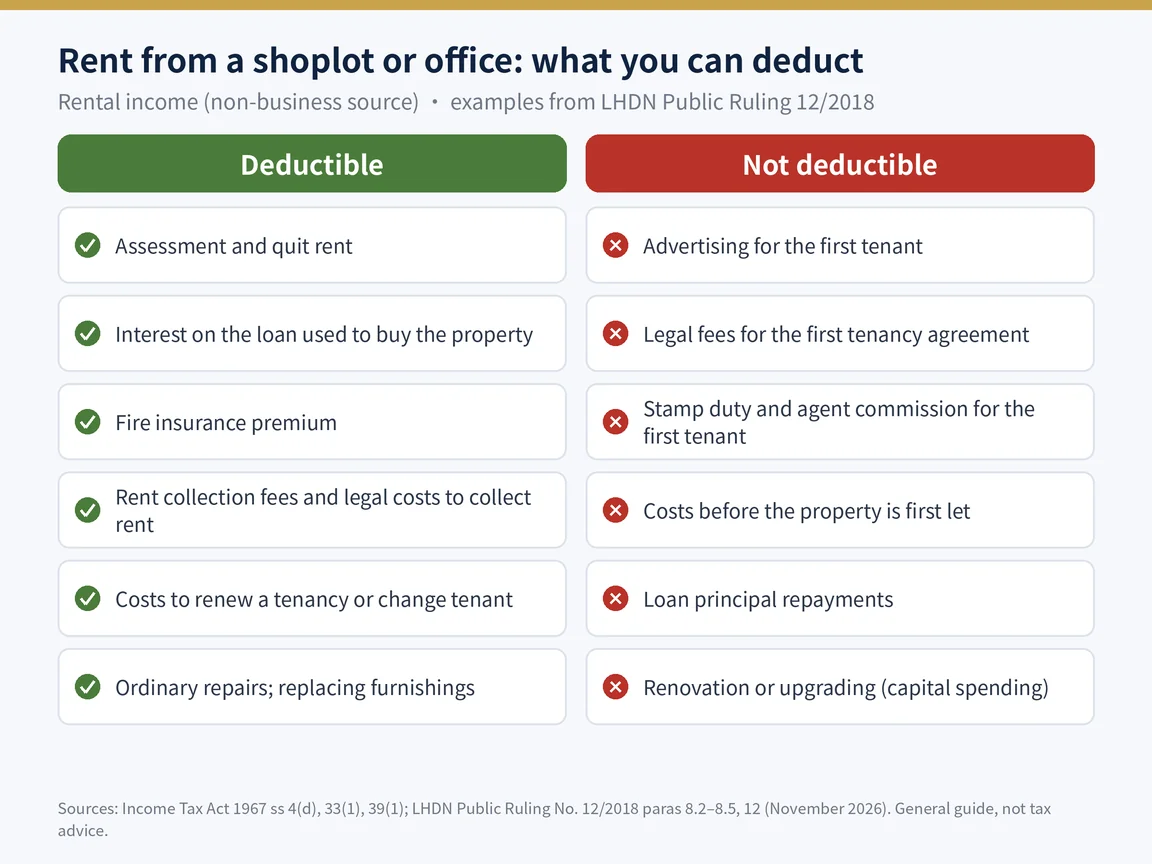
For rental income, LHDN allows direct costs that are wholly and exclusively incurred in producing the rent. Its examples are:
- Assessment and quit rent paid to the council and land office (see our holding costs guide).
- Interest on the loan used to buy the let property. Only the interest, not the principal.
- Fire insurance premium on the property.
- Rent collection fees and legal costs to enforce rent collection.
- Costs to renew a tenancy or change tenant.
- Ordinary repairs that keep the property in its existing state, and the cost of replacing furnishings such as furniture or air-conditioners.
4. Costs you cannot deduct
- Initial costs of creating the rental source: advertising for the first tenant, legal fees for the first tenancy agreement, stamp duty and agent commission.
- Costs for the period before the property is first let. If the tenancy starts mid-year, yearly costs are cut down in proportion.
- Renovation or upgrading that improves the property. That is capital spending, not a repair.
Vacant periods: once a unit has been let, its costs stay deductible while it is empty but clearly ready to let again. LHDN also allows costs during a temporary stop caused by repairs or renovation, no tenant for up to two years after a tenancy ends, a legal injunction or official order, or other events beyond your control, as long as the property is kept in good condition and ready to let.
5. A worked example
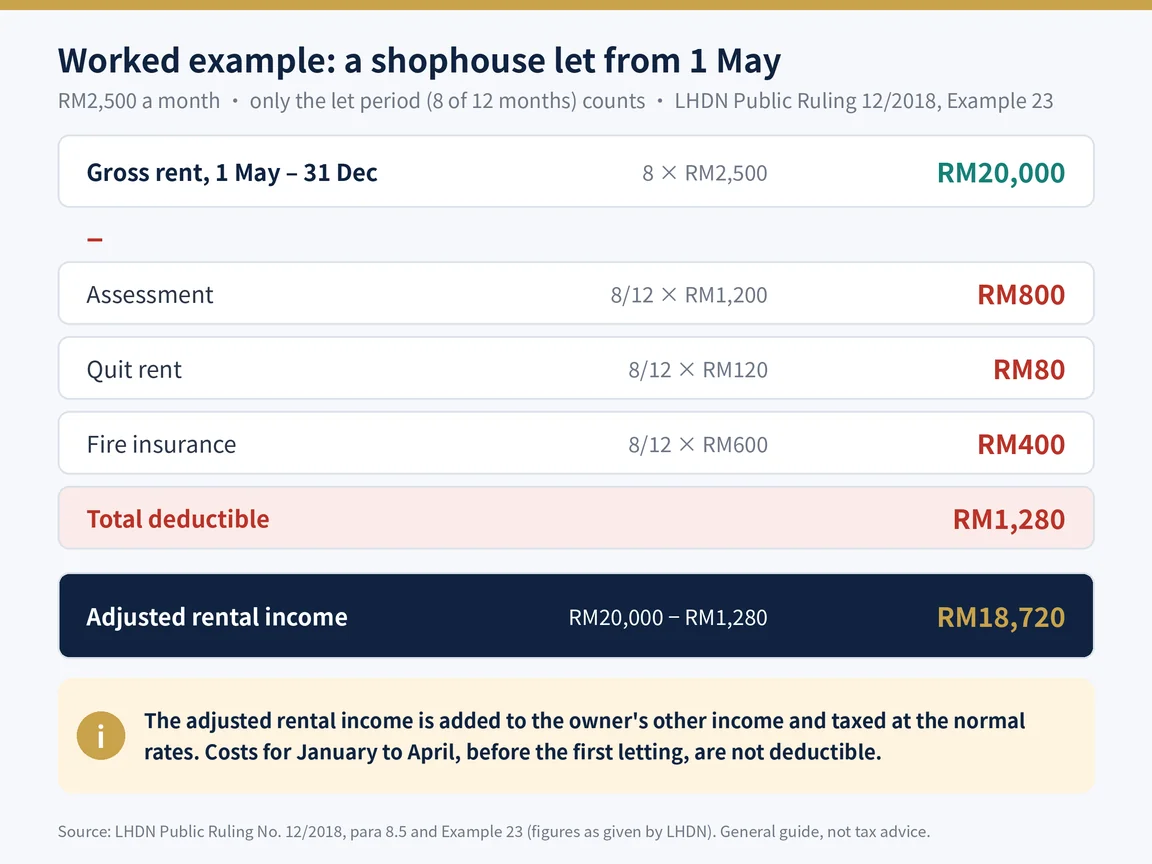
LHDN's own example: a shophouse is let from 1 May at RM2,500 a month. Gross rent for the year is RM20,000. The owner paid assessment of RM1,200, quit rent of RM120 and fire insurance of RM600 for the year, but only 8/12 relates to the let period, so RM1,280 is deductible. Adjusted rental income is RM18,720, which is added to the owner's other income and taxed at his normal rates.
6. Filing and records
- Individuals declare rent in e-Filing on MyTax. Form BE (no business income) is due on 30 April, with e-Filing allowed until 15 May. Form B (with business income) is due on 30 June, with e-Filing until 15 July. Late filing can lead to a penalty.
- Use LHDN's HK-4 working sheet to work out net rent. You do not attach receipts, but you must keep the tenancy agreement, rent records and receipts for seven years.
- Rent earned by a company goes in the company's own return; see our company ownership guide.
- Service tax on commercial rent, where it applies, is a separate tax. See our shoplot and office renting guide.
Practical tip: keep rent in one bank account, and ask your lender each year for a statement showing the interest paid. Ask contractors to separate repair work from upgrades on their invoices.
This guide is based on the Income Tax Act 1967, LHDN Public Ruling No. 12/2018 and LHDN's 2026 filing programme, as at November 2026. Rules can change. Ask a tax agent or LHDN about your own case.
Buying a shoplot or office for rental income, or looking for a tenant? Chat with PropertyMsia on WhatsApp and we will help you check the numbers.
Talk to a registered agent for free advice on pricing, zoning and due diligence.
Get in touch Commercial Listings