Business Premises Licence and Signboard Permit for a Shoplot or Office in Malaysia
What owners and tenants should check before opening a business in a shoplot or office in Malaysia: the local council business premises licence and signboard licence, zoning, title category and CCC checks, Bomba and food premises rules, typical documents, fees, renewal, penalties, and what to put in the tenancy agreement.
Updated 18 Nov 2026 · PropertyMsia
In short: In Malaysia you generally need a business premises licence from the local council (PBT) before you trade from a shoplot or office, and a separate advertisement licence for the shop signboard. Many councils issue both together as a composite licence. The council looks at the building as well as the business, so zoning, approved use and the CCC must be in order. Check this before you sign a tenancy or buy.
1. Who licenses what
- Local council: premises and signboard licences are issued under each council’s by-laws made under the Local Government Act 1976. In Kuala Lumpur, DBKL uses the Licensing of Trades, Businesses and Industries (Federal Territory of Kuala Lumpur) By-Laws 2016 and the Advertisements (Federal Territory) By-Laws 1982.
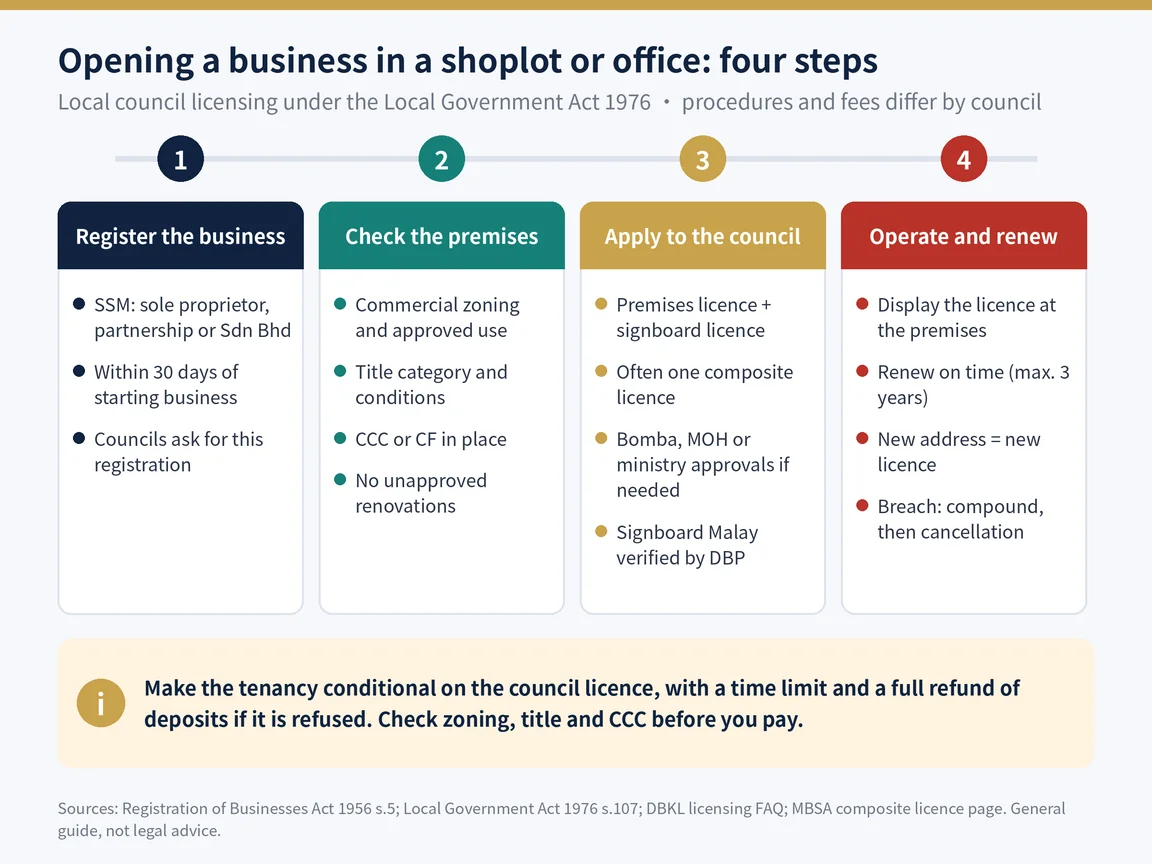
- SSM first: councils ask for your business or company registration. A sole proprietorship or partnership must apply to register within 30 days of starting business.
- Other agencies, depending on the business: Bomba, the Ministry of Health for food premises, and the relevant ministry for clinics, tuition centres, nurseries or money lending.
2. Check the premises before you sign
- Zoning and approved use: DBKL will not license business premises in a residential zone unless a change of use is approved first by its planning department.
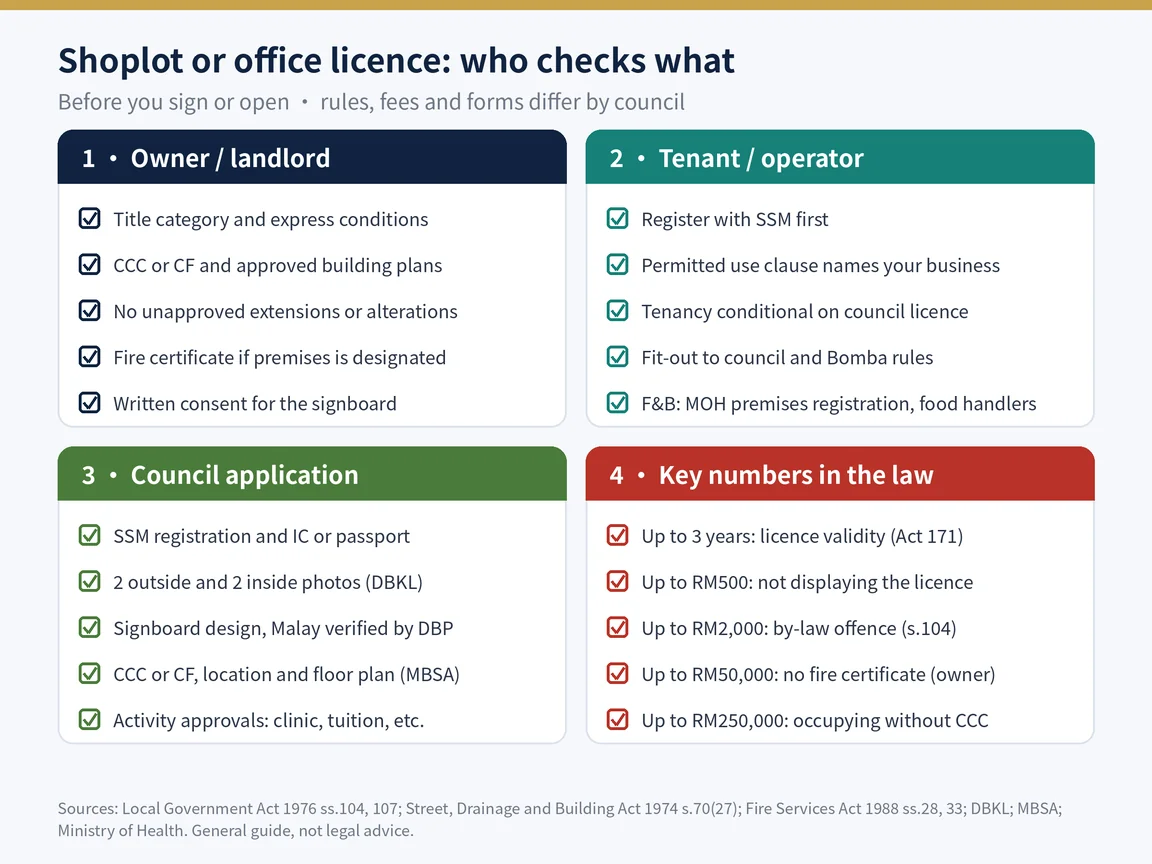
- Title: every title carries a category of land use (agriculture, building or industry) plus conditions. If the use breaches a condition, the land becomes liable to forfeiture, or the Land Administrator can impose a fine of at least RM500, plus at least RM100 a day while the breach continues.
- CCC or CF: occupying a building without a Certificate of Completion and Compliance, or allowing someone else to, is an offence carrying a fine of up to RM250,000, up to 10 years’ jail or both. Older buildings may have a Certificate of Fitness (CF) instead. MBSA (Shah Alam) asks for a copy of the CCC or CF with the licence application.
- Unapproved works: DBKL refuses applications for reasons such as extensions without approval, a single staircase that breaches the building by-laws, fire-safety gaps, no grease trap or tiles in a restaurant, and noise.
More detail: our due diligence checklist for a shoplot or office.
3. The signboard licence
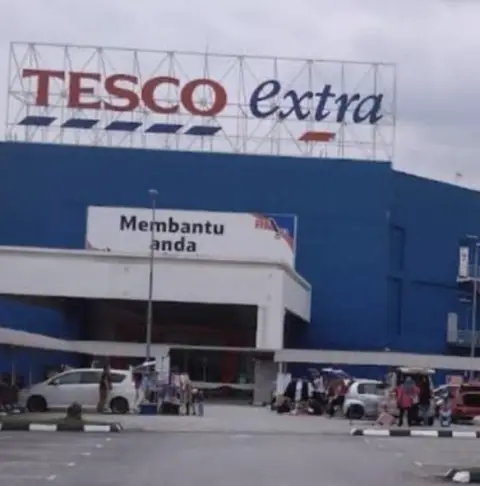
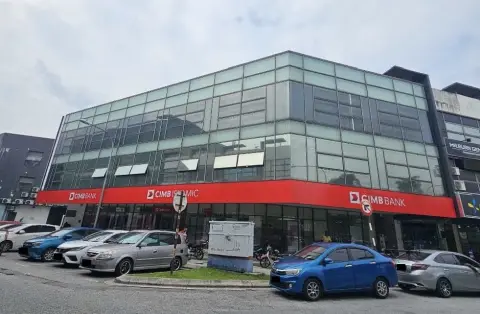
Using DBKL as an example: Malay must come first on the signboard in size, colour and position, and the Malay wording is checked with Dewan Bahasa dan Pustaka before you apply. Liquor and cigarette visuals are not allowed, and the board must not cover windows or the facade. A premises signboard licence needs a valid premises licence. Size and position rules differ from council to council.
4. Documents, fees and renewal
- Typical documents (DBKL): SSM registration, the applicant’s identity card or passport, a colour design of the signboard with its location, two photos of the outside and two of the inside of the premises, plus activity approvals where needed. MBSA also asks for the CCC or CF, a location plan and a floor plan.
- Fees: each council sets its own. DBKL’s yearly rates include RM200 per unit for an office, RM3 per square metre for most trades and food outlets, and RM50 per square metre for health and beauty centres.
- Validity and renewal: under the Act a licence lasts no more than three years. DBKL licences are paid yearly and can be renewed online. A licence follows the address, so moving to another unit means a new application.
5. Fire, food and penalties
- Fire certificate: premises designated under the Fire Services Act 1988 need a fire certificate, renewed every year. If none is in force, the owner commits an offence, with a fine of up to RM50,000, up to five years’ jail or both. Ask Bomba whether your unit is designated.
- Food and beverage: food premises must be registered with the Ministry of Health (valid three years). Food handlers must attend a recognised food handler course and have a typhoid vaccination, repeated every three years.
- No licence: breaching a council by-law can lead to a fine of up to RM2,000, up to one year’s jail or both, plus up to RM200 a day if it continues. For breaches of licence conditions, DBKL issues a compound, then a show-cause letter, and finally cancels the licence. You must also display the licence; failing to do so carries a fine of up to RM500.
6. Owner and tenant: put it in the tenancy
- Permitted use: the tenancy should name your actual business, and the landlord should confirm the title and approvals allow it.
- Licence condition: make the tenancy conditional on the council licence, with a time limit and a full refund of deposits if it is refused.
- Documents and works: the owner supplies the title, CCC or CF and approved plans. Agree who pays for compliance works such as fire equipment, a grease trap or approved renovations, and get written consent for the signboard.
See our guides to renting a shoplot or office, shopoffice vs retail lot titles and strata shop and office units, where the management body’s rules also apply.
This guide is general information based on the laws above and DBKL, MBSA and Ministry of Health information as at November 2026. It is not legal advice. Rules, fees and forms differ between councils, so confirm with your own council before you commit.
Looking for a shoplot or office that can be licensed for your business? Chat with PropertyMsia on WhatsApp and we will help you shortlist units and check the approvals before you sign.
Talk to a registered agent for free advice on pricing, zoning and due diligence.
Get in touch Commercial Listings